






Will AI change everything? Monaco explores the contours of a revolution

Leonardo Fabbri, founder of AI Monaco © Andrea Cabiale
The Principality established itself on Saturday, November 22, as a laboratory for reflection on the technological, economic, and societal stakes of AI, bringing together international experts and local decision-makers around an ambitious program at the second AI Monaco conference.
A revolution underway
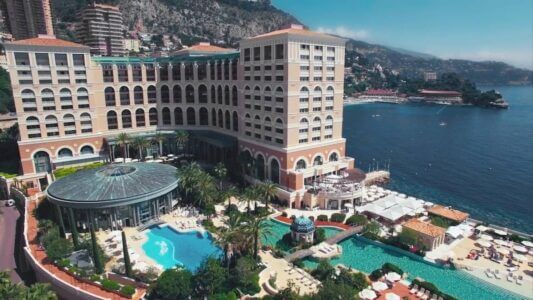
“We are living through a revolution,” declared Leonardo Fabbri, founder of AI Monaco, during his opening speech on Saturday, November 22, at One Monte-Carlo. Facing an amphitheater filled with family offices, entrepreneurs, and institutions, he set the stage for a day dedicated to the upheavals caused by artificial intelligence: “We’re going to see much of our workload being offset by AI.”
The figures he presented testify to a historic shift. Since the launch of ChatGPT, investments in data centres have exploded while construction of traditional offices has collapsed. “The hyperscalers are spending 100 billion per quarter to create the future,” he emphasised, noting that these amounts represent “15% of their top line, of their revenue, and 50% of their bottom line on average—those numbers are incredible and we have never seen anything like that in the past.”
Are we in a bubble?
Addressing the question preoccupying all investors, Fabbri was reassuring while remaining clear-eyed. “Most of the people that I speak with are saying, look, I think we might be in a bubble,” he acknowledged. Yet comparisons with the 2000 dotcom bubble reveal a very different situation: “The average PE was 89x. Now we are at 28, so much lower.”

An international panel of experts
This second edition brought together eleven leading speakers. The morning was launched by Manuel Bevand, R&D head at PokerStars and AI explorer for over twenty years, followed by Monegasque Ian Sosso, founder of Monte-Carlo Capital. Michelle Sisto, AI Dean at EDHEC Business School, detailed the new challenges of education. Gabriel Greco, founder of Quintessential Capital Management, presented his work on financial analysis and market anomalies, while Filippo Ghirelli, founder of Infracorp, addressed investments in decentralised AI.
When artificial intelligence becomes the beating heart of tomorrow’s medicine
The afternoon explored legal dimensions with Silvia Andriotto, a lawyer specialising in technology, and artistic ones with Geoffroy Staquet of Les Ballets de Monte-Carlo, who presented the ballet Coppél-I.A. Giada Franceschini, CEO of Boosha AI, introduced agentic AI, while Marco Ripani, research director at the National Institute of Nuclear Physics, addressed energy resources. Carlo Antoniazzi of Aream & Co. explored gaming, followed by Gregory Gadzinski, finance professor at IUM. Thomas Rodier, founder of Wink Monaco, concluded with the philanthropic dimension.
Energy, the real battleground
“Energy is probably the most important factor in the world in developing AI,” Fabbri insisted. “People are starting now to understand that if you want to win the AI race, you need to win first the energy race.” The United States thus plans to build an additional 117 gigawatts by 2030, equivalent to powering Italy, the UK, and Spain combined.
When artificial intelligence becomes the beating heart of tomorrow’s medicine
“I’m very satisfied with how the conference went,” concluded Leonardo Fabbri. “Our objective is to continue building this platform, where cutting-edge AI research meets concrete applications and long-term strategic thinking. We now look forward with anticipation to our next meeting at the Yacht Club in May 2026.”