





Talents Handicap: “Any person with a disability can work”

© Groupe Talents Handicap
Since 2009, Redwane Bennani, founder of Talents Handicap, has been working to make employment more accessible for people with disabilities.
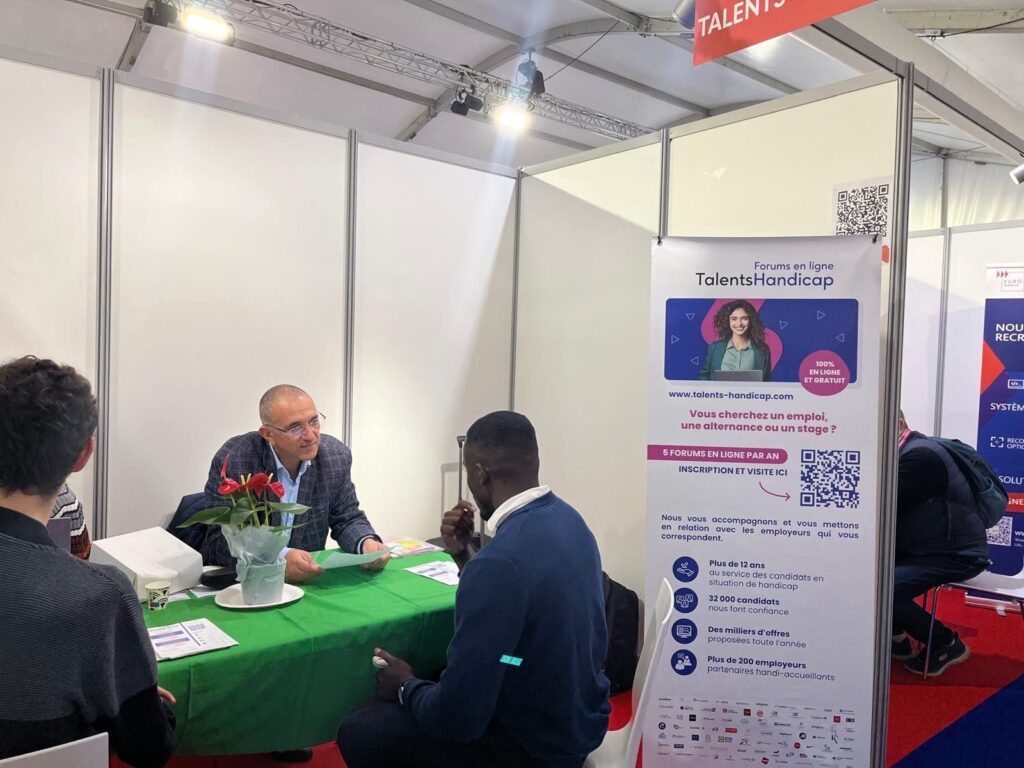
New Net 3D was founded in 2009 and shifted its focus in 2012 towards employment and disability through partnerships with research laboratories. The company, which has twelve employees, now organises five virtual job fairs every year. The first two events of the year promote apprenticeships — a training pathway with no age limit for people with disabilities, serving as a genuine springboard for employment, supporting career changes and the development of new skills in growing sectors.
A forum in June highlights IT professions, while another in September showcases customer relations roles — two key sources of employment. Finally, the national SEEPH special forum, organised in November to coincide with the European Week for the Employment of People with Disabilities, is the main annual highlight, combining recruitment, awareness-raising and recognition of disability-inclusive employers. The programme features themed webinars, online employer–candidate meetings, access to the “Académie de l’inclusion/Inclusion Academy” game and targeted communication for companies participating in DuoDay.
Breaking down prejudices about disability at work
“Many people have preconceptions, which are a major obstacle. People wrongly believe that disability prevents you from working — that’s absolutely not true. Any person with a disability can work. They just need to choose a suitable job that matches their abilities.” A little-known fact: 80% of disabilities are invisible. Chronic illnesses (diabetes, cancer, hypertension), cognitive disorders (autism, ADHD, dys- disorders), and visual or hearing impairments all fall under the definition. “The definition of disability in France has changed a lot since the 2005 law. It’s the environment that creates the disability, not the person.”
The shift has helped to include chronic illnesses and cognitive disorders within the scope of disability, significantly expanding the possibilities for official recognition. “What drives us isn’t economic performance, it’s human performance. Seeing a candidate regain confidence, a company open up to difference, a team change its outlook — that’s what motivates us, and that’s where the real impact lies.”
Far from limiting itself to recruitment, Talents Handicap offers a holistic approach: a recruitment platform, a specialised CV database, certified training courses, awareness webinars and individual support for employees. “We come with a complete solution to be a genuine partner to the company. Everything is connected — recruitment, training, awareness, support.” The integrated approach is crucial: “Imagine we present a great candidate to a manager who’s not aware of disability issues. Unconsciously, that candidate might be rejected,” explains Bennani. “If the manager lacks understanding, they may have prejudices or fears about what they don’t know.” Hence the importance of training recruiters and managers to adopt an inclusive attitude and adapt their practices. Recruiters need more awareness: “They receive a lot of applications and tend to favour linear career paths. But with a disability, there may be gaps in the CV — a break due to illness, or a non-linear journey because of a career change.” Talents Handicap therefore includes short training sessions for recruiters during its forums, as well as comprehensive programmes through its Qualiopi-certified Talents Handicap Formation service.
In 2025, Talents Handicap quadrupled its number of candidates while maintaining its focus on quality: “Quantity is counterproductive.” The philosophy has already attracted major companies. “We’re not talking about integration — these candidates want to join a company where they’ll find an inclusive environment. Companies are competing for candidates. They want to be the ones chosen.” That’s why employer branding and visibility around inclusion efforts are so important.
Inclusive management benefits everyone
For over thirteen years, Talents Handicap has operated on one conviction: disability is a powerful driver of positive transformation. According to Redwane Bennani, the inclusion of people with disabilities benefits the entire company. Disability encourages more agile and personalised management — allowing more remote work, adapting tasks, or providing extra breaks. “You need to have inclusive management. The benefit is collective. Others become more engaged, more productive. It’s that collective performance we should focus on, not the individual.”
Although there is no legal requirement to employ people with disabilities in Monaco — unlike in France, where companies with over 20 employees must meet a 6% quota — Redwane Bennani remains optimistic: “We’d love to work with a Monegasque company. We’re showing businesses that investing in inclusion is a profitable investment. It’s about thinking in terms of sustainable and responsible performance.” Based in the Alpes-Maritimes, Talents Handicap has not yet worked with the Principality: “We’re neighbours, so we’d be delighted to support any company wishing to move forward in this area.”
In 2026, Talents Handicap plans to harness artificial intelligence to enhance its services while continuing to expand training and support. “It’s going to be a year of innovation. We’re a small company, so we try to stay agile and adaptable.” The commitment remains unchanged: “We work in good conditions for a good purpose — for companies, for candidates, for people, for employees. That’s what makes us proud,” said Redwane Bennani.