




Palace Merano: centenarian medical spa looking to the future without selling its soul

Palace Merano © Moggi
At a time when the wellness industry is booming and luxury clinics are proliferating, Palace Merano is proving that it is all about longevity – a lesson in resilience for this century-old institution that reinvents itself without ever losing its identity.
Inaugurated in 1906, then a military hospital during the Second World War, converted back into a palace hotel before becoming Italy’s first medical spa at the end of the last century, the Palace Merano embodies over a century of constant adaptation. Today, with the wellness industry growing exponentially, and the emergence of ‘wellness cities’ in Dubai and ultra-modern complexes in Europe, this Tyrolean institution remains the original that everyone tries to imitate – without ever managing to match it.
Heritage as its foundation, innovation as its horizon
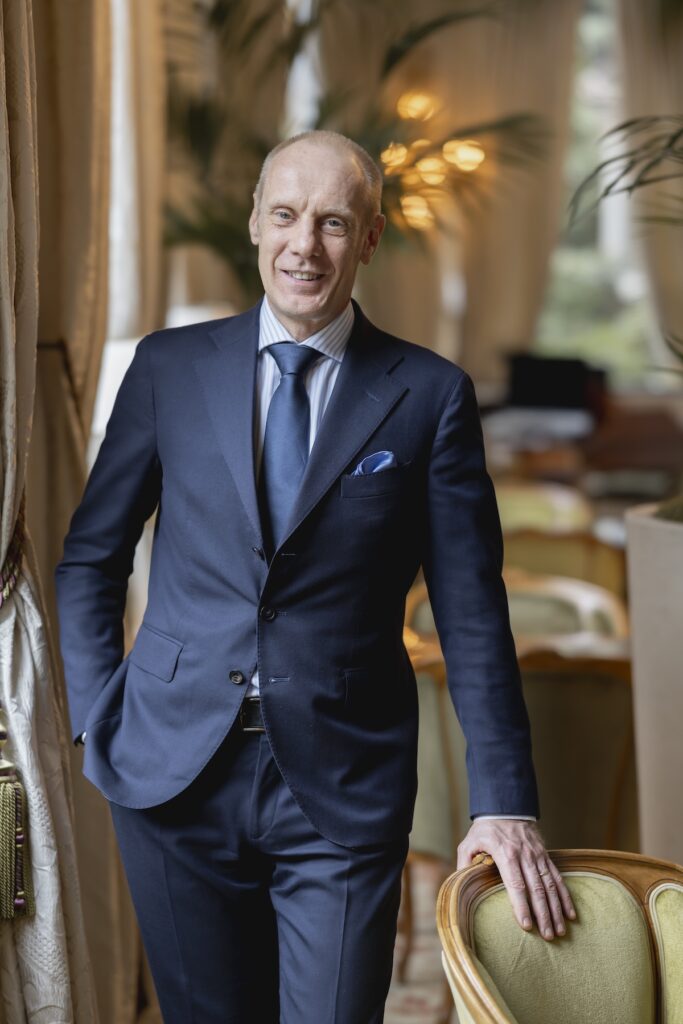
“When the creator of our Detox programme passed away, we could have lost our compass, but that didn’t happen. We managed to stay on course, like a Ferrari that has lost its prancing horse: the red car still goes as fast as ever. But the most important thing is that we’ve kept the whole team, the team that worked on the programme with him from the outset,” says Stefano Plotegher, who has been CEO for the past year.
The car metaphor sums up the gigantic challenge: how to maintain excellence when you lose the architect who shaped your identity for decades?
The answer lies in a silent organisational revolution. Where once everything was under the baton of a lone conductor, Plotegher has introduced a collegiate structure: medical innovation under the supervision of the doctor, Dr Massimiliano Mayrhofer, human resources, financial department, stratified management. “We’re building the Palace’s future around an organisation, not one person,” he explains. “The Palace must outlive individuals.”
What makes Palace Merano irreplaceable
In a market that is saturated with spas and wellness centres, what is it that still sets this venerable institution apart? “Merano itself,” replies Plotegher. “The earth, air, water and above all people – what I call fire, human warmth. This method’s five original elements.”
Maximilian Newiger expands on the unique vision: “Real luxury in today’s wellness and hospitality environment is for the customer to always feel like a guest, not a patient. The environment should give you positive energy and a zest for life.”
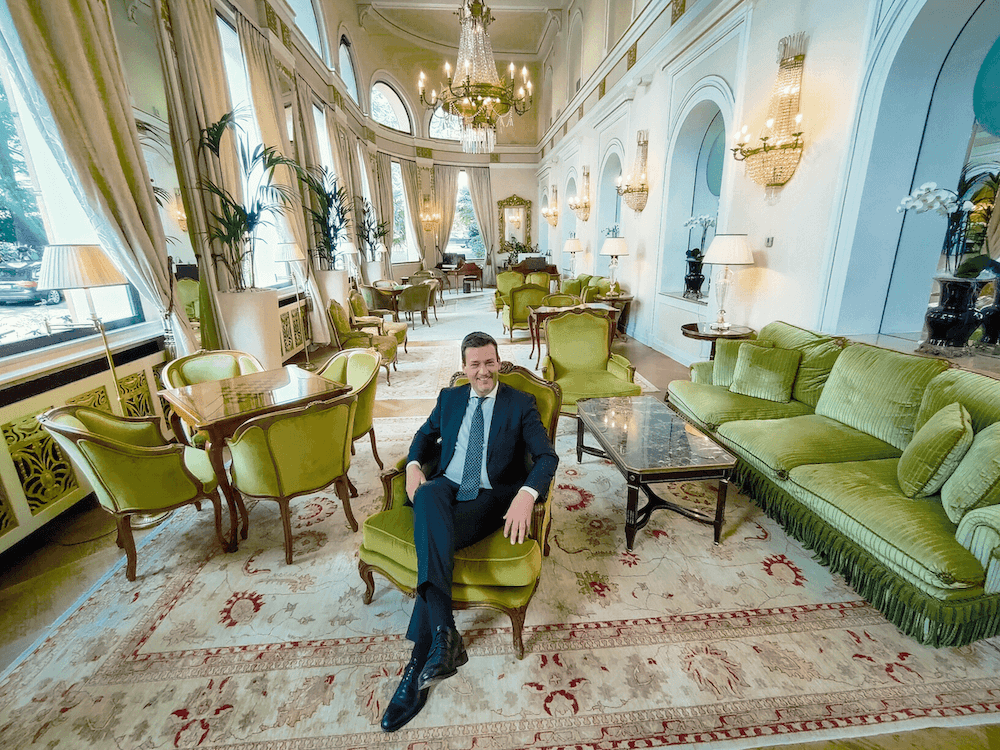
The Alpine-Mediterranean microclimate of Merano, a recognised climatic health resort since the 19th century, is one of the area’s key assets. The clean, dry air, stable temperatures, lack of fog and exceptional sunshine create ideal conditions for healing.
The incredibly pure water is an integral part of the treatments. The unique microclimate, at the crossroads of Alpine and Mediterranean influences, creates a naturally therapeutic environment that no technology can replicate elsewhere.
But geography aside, it is the approach that is unique. While other establishments focus on technology or ostentatious luxury, the Palace cultivates integrative medicine, where state-of-the-art DEXA scanners and traditional Chinese medicine coexist, and where there is an on-site analysis laboratory – a rarity in the industry – alongside acupuncture sessions.
New challenges: appeal without compromise
“The average age of our clientele is 56-57,” says Plotegher. “Our main challenge is to attract a younger generation without losing our loyal customers.” A delicate balance in a world where Generation Z switches quickly from one experience to another, and loyalty seems to be an outdated notion.
The strategy is to modernise without losing character. The new ‘Sport Performance’ and ‘Relax & Balance’ programmes are specifically aimed at younger, more active customers who are looking for performance as well as relaxation. The arrival of Alex Schwazer, Olympic champion turned fitness trainer, sends out a strong message: the Palace is no longer just a sanctuary for stressed-out top executives, but also for demanding amateur athletes and sportspeople.
The partnership with Zinédine Zidane, a customer for 30 years who has become an ambassador, illustrates this strategy of rejuvenation by example. “The message is not just about sport,” says Plotegher. “It’s that: even if you’re young, even if you’re an athlete, you can come here to be stronger, to find your balance.”
Stability as a philosophy, evolution as a necessity
“Our strength is that 80% of our customers are regulars,” says Newiger. “Zinédine Zidane has been coming here for 30 years. He came here when he was a football player, and at first he wasn’t too well-known. It was interesting to see the progression and the fact that he loved the place and continued to come for 30 years. What he appreciates most is the stability of the staff.”
That exceptional stability, with some employees still on board after over 30 years, is a major asset. “Our chef, Günther Pirhofer, has been here for 30 years. He’s a very inquisitive person, who has travelled a lot and maintains consistent quality,” says Newiger. “That’s not easy to find. These elements add joy to life and that’s true luxury.”
Awards recognising excellence
International awards galore endorse this strategy of controlled development. The Condé Nast Traveller Wellness & Spa Award 2025 in the “Master M.O.T.” category recognises the excellence of the diagnostics. The Luxury Spa Edit voted the Palace “Best Global Spa Hotel”. These awards are not for nostalgia, but for innovation rooted in tradition.
“These awards recognise our unique ability to combine medical discipline with a holistic approach,” says Newiger. “We are still the only ones with an in-house laboratory that provides results within three hours. That turnaround means protocols can be adjusted in real time – a luxury that few can afford.”
The future: more or better?
While competitors are opening more and more establishments, Palace Merano is choosing to focus on improving what it already offers. “We’re concentrating on Palace Merano,” says Plotegher. “Our strength doesn’t lie in multiplication but in the excellence of a single location.”
This philosophy of concentration rather than dispersion reflects a vision: in a world obsessed with growth, true longevity perhaps lies in the ability to remain oneself while evolving.
Palace Merano proves that you can be 119 years old and still be a pioneer, that you can lose your creator without losing your soul, that you can modernise without compromising yourself. In the wellness industry, where fleeting trends are the rule, this stability in change is perhaps the finest demonstration of what longevity really means: not to last, but to perpetually reinvent oneself without ever ceasing to be oneself.
Like the Passirio torrent, which has flowed by the palace for over a century: the water changes constantly, but the river remains.