




Do Monaco’s dogs look like their owners? A Rokethon investigation
When dogs become the mirror image of their owners © Monaco Tribune – sundaria_art
At the crossroads of science and social observation, a stroll around the Chapiteau de Fontvieille reveals surprising similarities between Monaco residents and their four-legged companions.
The question might raise a smile, but it fascinates researchers. Scientists from Germany’s Max Planck Institute of Geoanthropology have just confirmed what many dog owners long suspected: our canine companions really do resemble us. According to their study published in the journal Personality and Individual Differences, the similarities are no optical illusion. They transcend physical appearance and are rooted in temperament, behaviour and even personality traits. Women with short hair tend to prefer dogs with short ears, introverted people have dogs that are nervous around strangers and conscientious owners tend to have pets that are easier to train.
Last Sunday, at the Rokethon 2025, while Princess Charlene walked around the Chapiteau de Fontvieille with her chihuahua Harley, we decided to carry out our own investigation in Monaco. Armed with a microphone and a modest dose of scientific curiosity, we met participants to see whether the Principality confirms or disproves the theory.
Jérémy and Chiro: “Completely crazy!”
Jérémy with Chiro, five years old, adopted from the Monaco SPA


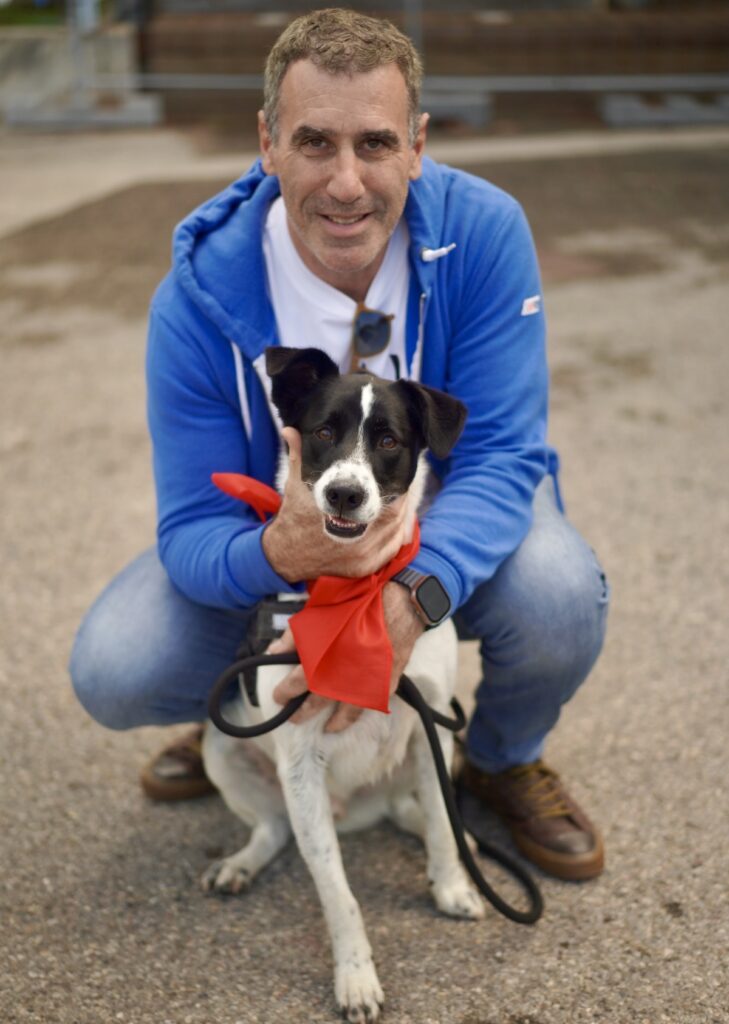
“Not at all, he’s completely crazy!” protests Jérémy when asked if he resembles his dog. Yet, as he describes Chiro’s character, the similarities start to show despite himself. “When he’s happy, he’s happy 1,000%, and when he’s sad, he’s sad 1,000%.” An all-or-nothing temperament that seems to echo his own. “Like you?” we ask. “Yes, yes, I suppose so,” he admits with a knowing smile. Adopted at one year old, Chiro had a difficult start, but now their days are filled with walks, runs and agility sessions. And he’s not alone: Jérémy also took in Chiro’s sister, both adopted from Monaco’s SPA. They’re a blended family clearly sharing the same boundless energy.
Cristina and Boo-Boo: a personality in progress
Cristina with Boo-Boo, four months old, a surprise birthday gift
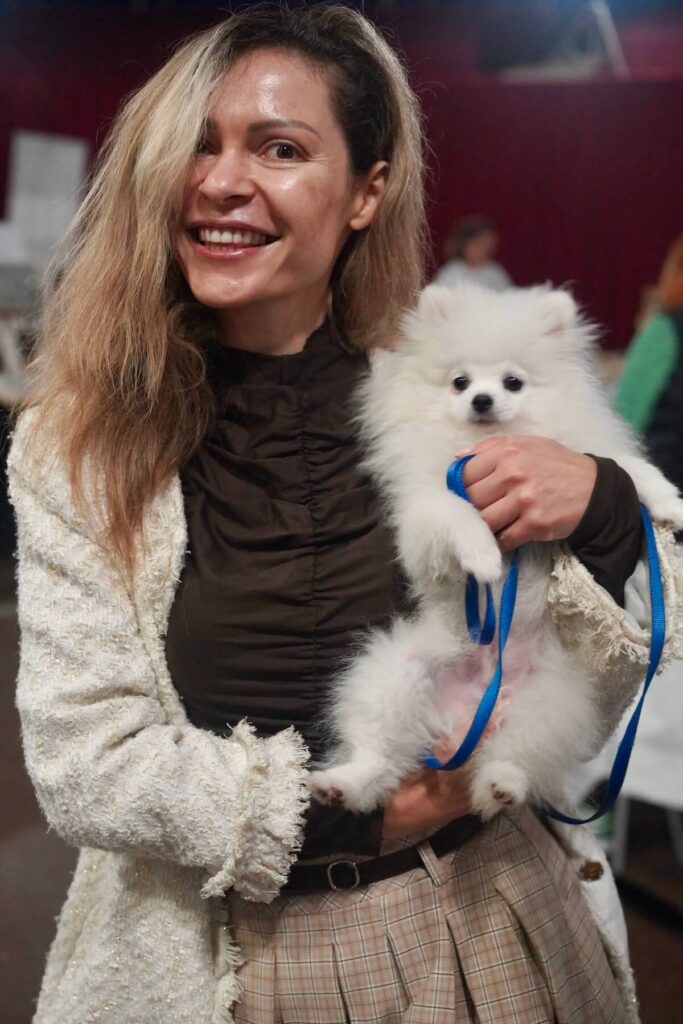
At just four months, Boo-Boo is still forming his personality. “He’s developing his character,” explains Cristina, who received the puppy as a birthday present from her best friend. For now, the signs are promising: Boo-Boo is becoming like her — sociable, eager to meet people, always ready to go out. “He loves being outside, he loves meeting people,” she says. Their favourite activity? Playing fetch in the park, of course, surrounded by other dogs. The German study also notes that similarities between dog and owner increase over time, shaped by cohabitation. In a few months, Boo-Boo may well be the perfect reflection of Cristina’s extroversion.
Tamara, Styl, Veronica and David’s tribe: three dogs, three personalities
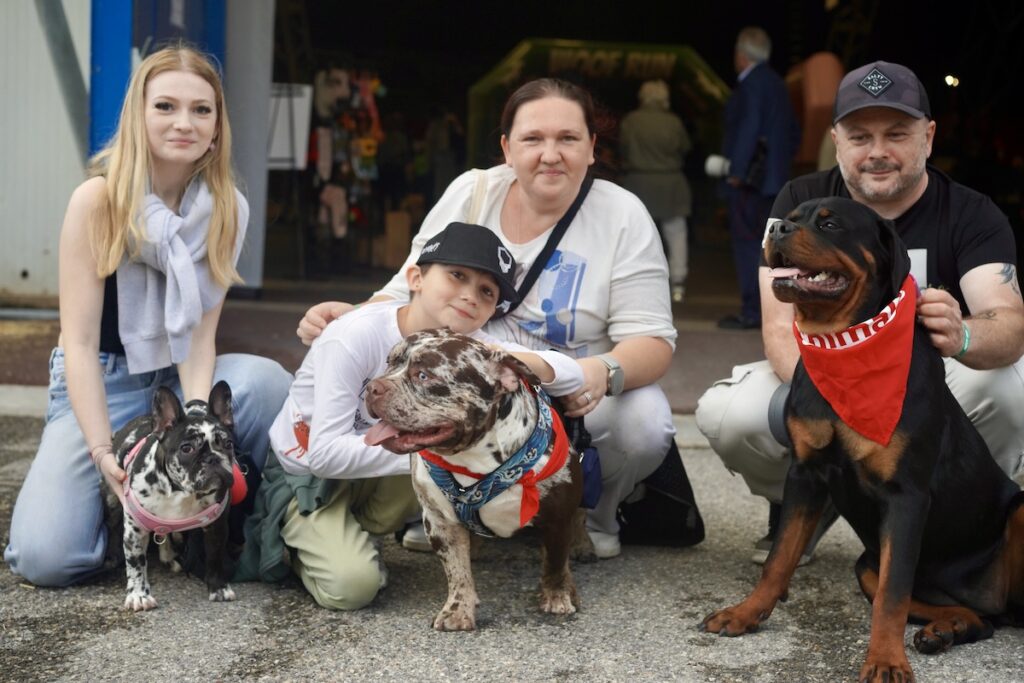
The family with Kira (rottweiler, one year), Mini (American Bully, seven months) and Athéna (French bulldog, four and a half months)
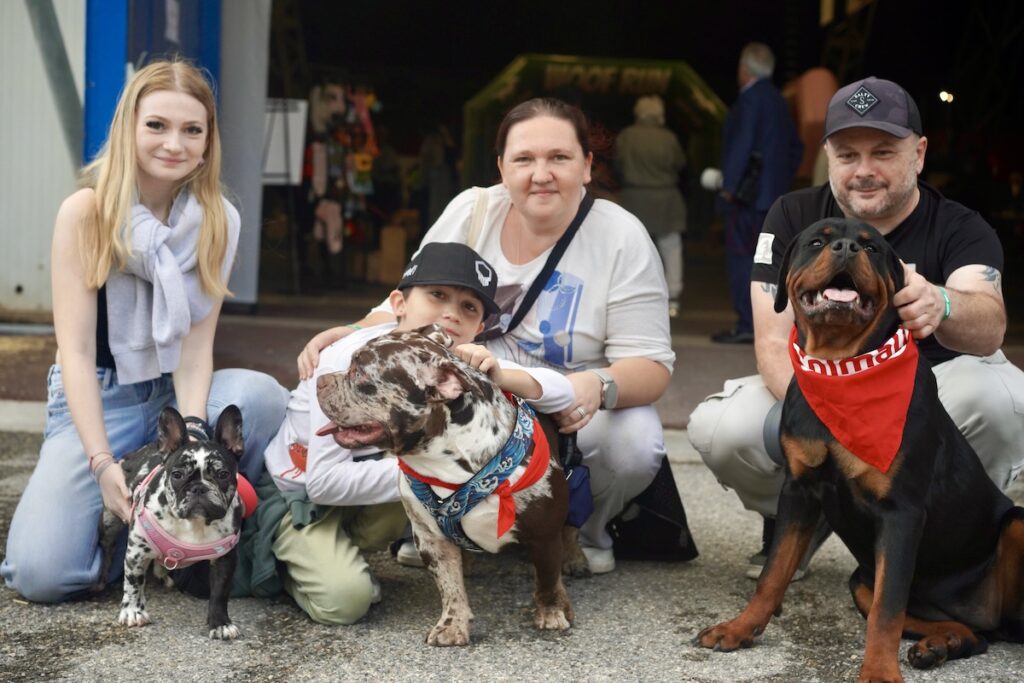
In this family, everyone has their dog. Kira, the rottweiler, is shy and calm. Mini, the American Bully, is completely wild. And Athéna, the French bulldog, falls somewhere in between. “She’s shy and calm. Crazy. And him, he’s half crazy too,” summarises Tamara, pointing to each dog. When asked whether these temperaments resemble them, the family nods in agreement. Interestingly, Kira, despite being a rottweiler, was not listed as a dangerous dog when registered. The family forms a solid unit with their pets — going out in groups with other owners, organising forest outings. Three dogs, three reflections of one tribe.
Geraldine and Ninja: martial artists in motion
Geraldine with Ninja, four years old, born 11 November 2021
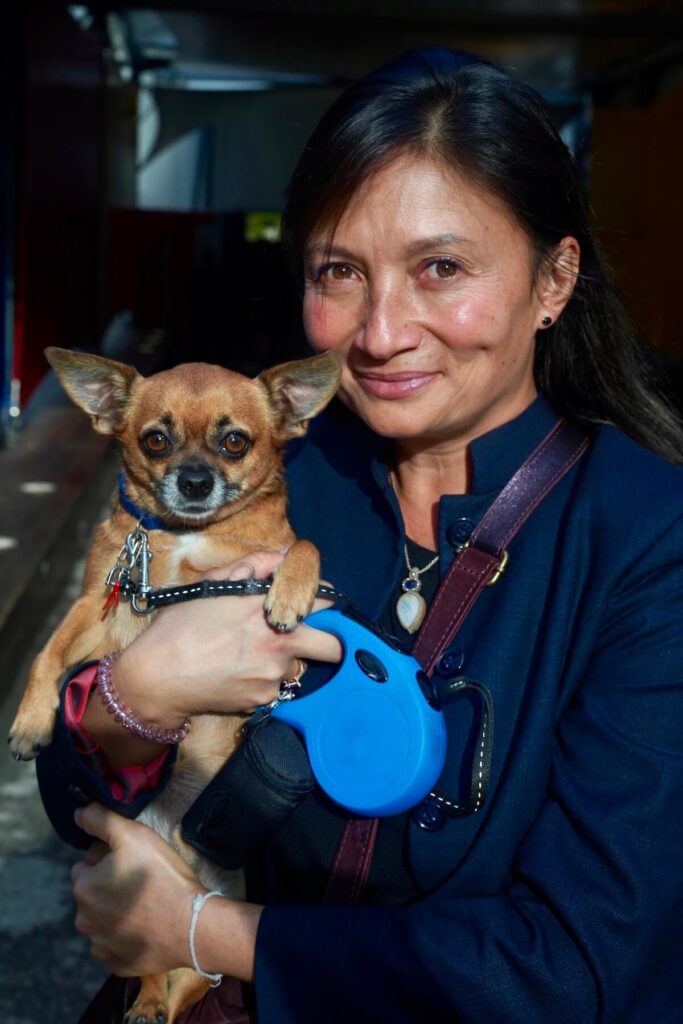
“He’s a ninja. He’s very fast, very sharp. Sometimes you don’t know where he is — you literally can’t hear him,” says Geraldine in English. To keep track of her stealthy companion, she had to fit him with a little bell. Able to run ten kilometres in the morning with his owner, Ninja embodies the agility and precision of martial arts. “Does that resemble you?” “Yes, absolutely. The martial arts side is definitely there.” Beyond that, Ninja accompanied Geraldine through a personal journey of healing. “Without him, my recovery wouldn’t have been easy,” she confides. Here, the resemblance goes beyond looks — they’re soulmates.
Carina and Kelly: passing on the torch
Carina with Kelly, a seven-month-old dachshund, originally owned by her daughter
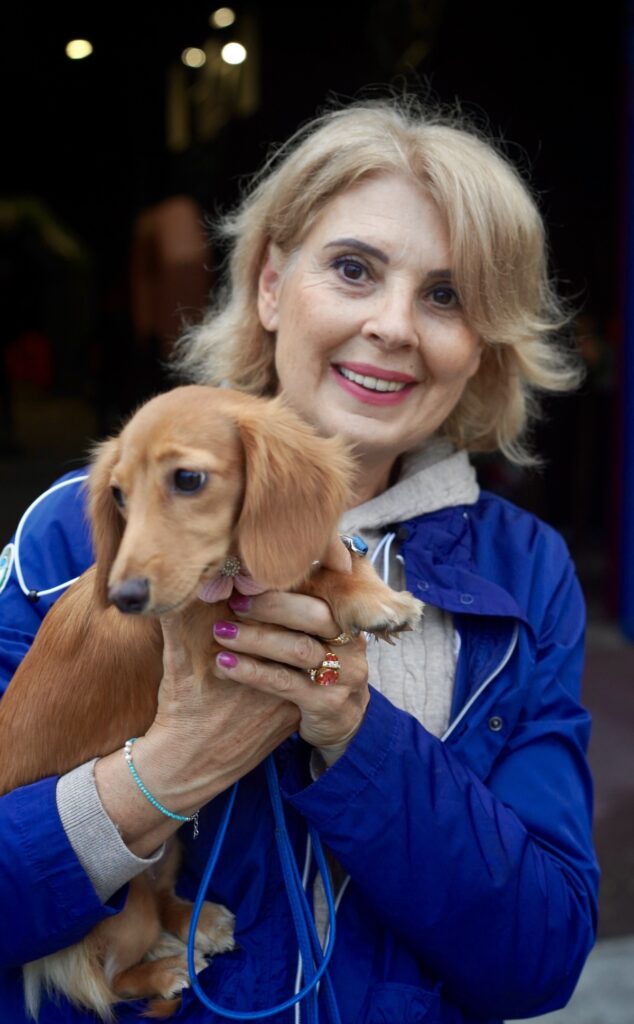
Kelly’s story is one of a fortunate twist of fate. “Actually, she’s my daughter’s baby girl,” explains Carina. Her 19-year-old daughter, caught up with studies and internships, couldn’t take care of the puppy. So Kelly ended up “at grandma’s”. Perhaps it was fate, because despite her initial reluctance, Carina now recognises the similarities. “At four months she was already growling at other dogs. She’s got quite a bit of character.” At home, Kelly learns from her “grandmother” dog, Carina’s 13-year-old companion who is now unwell. Between daily walks and gentle training, Kelly is gradually asserting herself — a mirror of a strong personality.
Maria and Jady: elegance embodied
Maria with Jady, a four-and-a-half-year-old Shiba Inu from Moscow
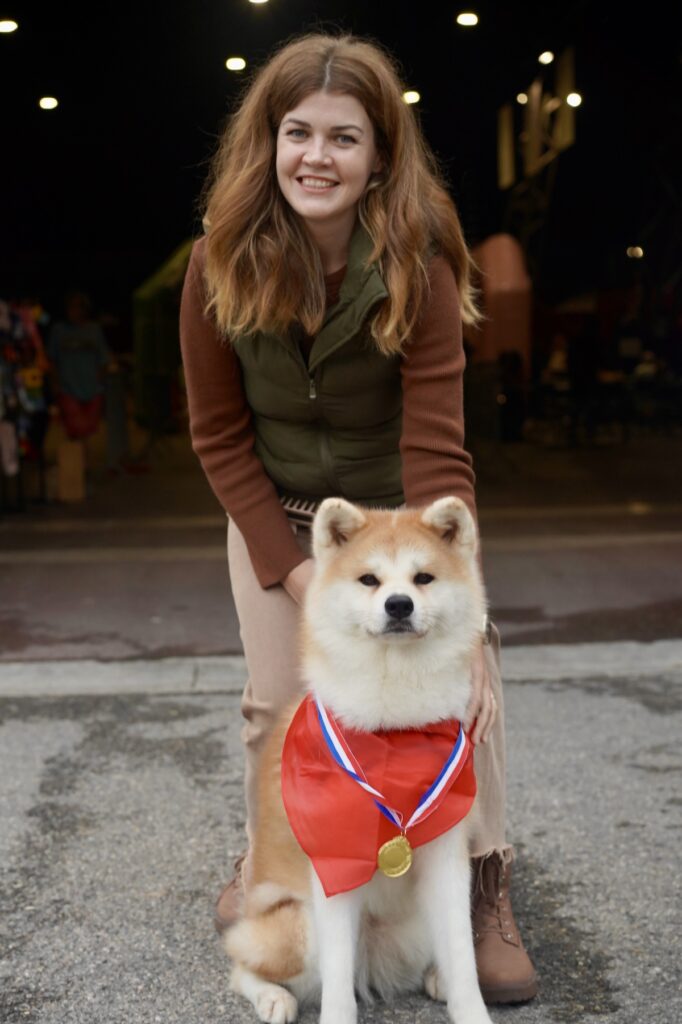
If a dog could be aristocratic, it would be Jady. “She’s very solitary, very calm. She likes to stay in the centre, among people, but she never jumps on anyone. She just lies on the floor, like a decoration,” says Maria. A discreet but noble presence, “like a little princess, very elegant.” Brought from Moscow by Maria, Jady was a sick puppy in need of a foster home. Now trilingual (Russian, French, Italian), she accompanies her owner everywhere — shopping centres, cafés, restaurants. “Does she resemble you?” “VERY much so,” replies Maria without hesitation. Quiet elegance, gentle reserve, distinction — everything fits.
Fiamma and Ritz: a shared second chance
Fiamma with Ritz, five years old, adopted from a shelter in Puglia
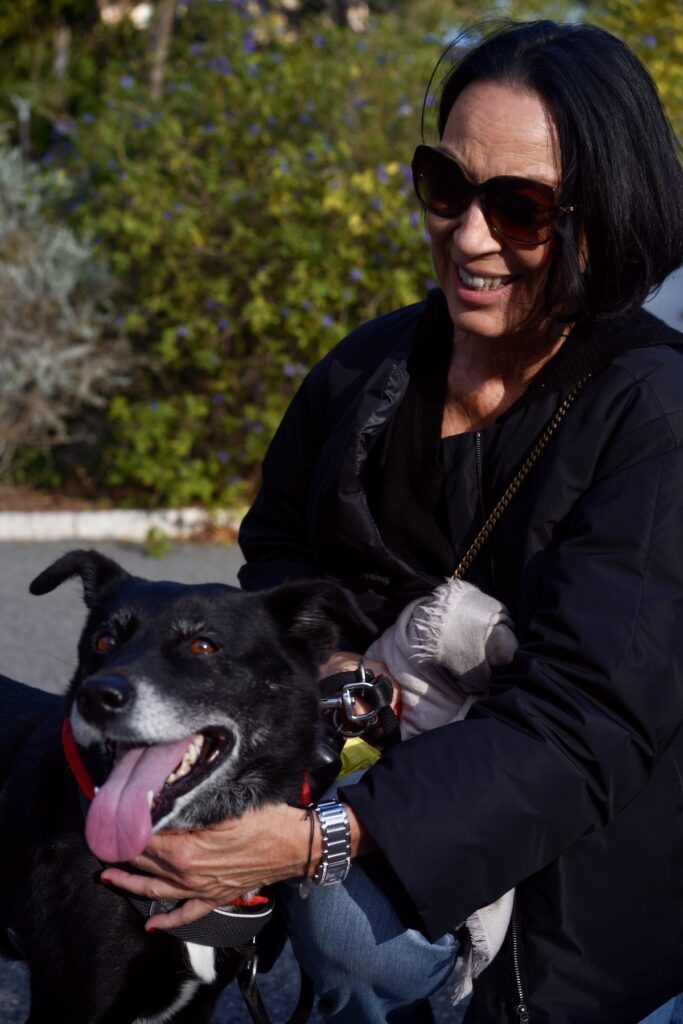
Ritz comes from far away — from a shelter in Trani, in Italy’s Puglia region, run by the charity La Zampa sul Cuore. “He’s mad, completely crazy, always wants to play, but he’s still a bit scared,” explains Fiamma in Italian. Five years after his adoption, he remains her constant companion. “Wherever I can take him, he comes with me. We’re almost always together — he’s my partner.” Bilingual like his owner (Italian and French), Ritz found his family in Monaco. The bond between them leaves no doubt: the resemblance is there, woven from five years of shared life.
Marie-Christine, Milka Massima von Märchenland and the Peruvian cause
Marie-Christine and her mother, visiting from Germany with their Yorkshire Terrier Milka Massima von Märchenland
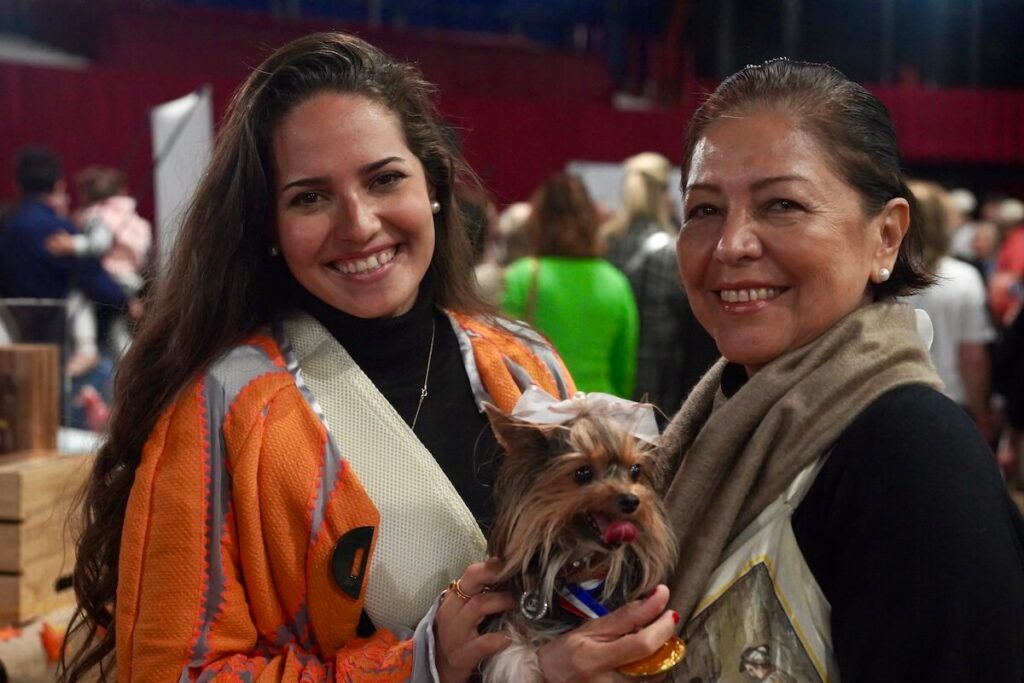
In Monaco especially for the Rokethon, Marie-Christine and her mother share more than a dog — they share a cause. Both belong to a group helping children in South America and caring for abandoned dogs in Peru, their country of origin. “In the city where I come from, my daughter and I try to help abandoned dogs,” says Marie-Christine’s mother. Milka Massima von Märchenland, their German dog, is the living symbol of their transnational commitment. When asked if they resemble their dog, they answer immediately: “Yes, of course!” With touching clarity, her mother adds that it is Milka’s behaviour that most reflects Marie-Christine’s. A bond transcending both borders and species.
The Monaco verdict
Our mini-investigation at the Rokethon confirms the German researchers’ observations. In Monaco, as elsewhere, dogs gradually become the reflection of those who love them. Some similarities appear from the start, others form over the years, shaped by shared life, routines and emotions.
Beyond scientific curiosity, these encounters remind us of a fundamental truth: our dogs are not mere pets. They are full members of our families — mirrors of our souls, silent witnesses to our joys and our trials. They deserve our time, our care and our unconditional love.
Since if our dogs end up resembling us, it may be because we give them the space to become who they truly are — not objects, but living, feeling beings, capable of absorbing and reflecting the essence of those who cherish them. In caring for a dog, we do more than raise a companion. We shape, often without realising it, a smaller, purer, more faithful version of ourselves.
As Sylvia Sermenghi reminded us, abandonment is suffering. But beyond the fight against mistreatment is the celebration of a unique bond — one that turns two different beings into a single, inseparable family.