

Electric boats: what if the true pleasure lay in navigating the seas differently?

The MODX 70 is a 100% electric catamaran designed by the Yacht Club de Monaco, equipped with a hydrogen fuel cell, used both by race committees and as an observation base for the Pelagos sanctuary © Maeva Bardy
On 20 November, at a dinner-conference held during ‘Les Jeudis de la Villa Ephrussi de Rothschild’, Guillaume Jacquet-Lagrèze, entrepreneur and member of the French Association for Electric Boats (AFBE), presented an overview of the innovations transforming leisure boating on the Côte d’Azur.
“Electric leisure boating is not just about propulsion and speed, it’s also about a new way of using boats,” declared Guillaume Jacquet-Lagrèze to guests gathered in the patio of the villa’s Béatrice restaurant overlooking the Mediterranean. Based in Beaulieu-sur-Mer for ten years, where he offers solar-panel-powered boat excursions, the entrepreneur has welcomed more than 17,000 visitors and travelled 17,000 kilometres without ever recharging his batteries on the electrical grid.
Leisure boating at a turning point
The initial observation is clear: traditional leisure boating is losing momentum. The average age of boaters is now in the fifties and actual time spent using boats remains limited. According to the Federation of Nautical Industries (FIN), a boat is taken out an average of only 20 to 25 times per year. Registrations of new boats have fallen by 25.5% since 2018–2019, while “waiting lists in ports are beginning to shrink on certain coasts such as the Atlantic,” Guillaume Jacquet-Lagrèze noted.
Paradoxically, enthusiasm for sea-faring remains strong: nearly 100,000 boating licences are issued each year in France, compared with 50,000 to 70,000 in the early 2010s. “People are increasingly seeking experiences rather than ownership, and they tend to turn towards rentals,” the head of SeaZen explained, pointing to new expectations within the leisure boating sector.

From an environmental standpoint, while the impact of leisure boating on carbon emissions remains marginal compared with other sectors and industries, two environmental issues merit particular attention today. Anchors damage posidonia seagrass meadows, underwater prairies that take a century to grow by one metre, and above all, “underwater noise affects all marine species, from cetaceans to seagrasses.” These are two challenges that the electric propulsion method is also striving to address.
Innovating for efficiency
Faced with the difficulty of storing enough energy to match the range of combustion engines, electric boat builders are competing in ingenuity. Foils – submerged wings that lift the hull out of the water – save up to 40% energy while offering quiet, wave-skimming navigation. Since July 2024, Monaco has hosted electric foil-boat competitions and now has its own team competing on the world circuit.
Another technology consists of building a kind of flying vessel: “There is what we call the ground effect. At a certain speed, the boat lifts thanks to the effect of an air cushion that forms between the hull and the water.”
Solar energy also represents another promising path: the large surface area of catamarans allows enough panels to be installed to achieve energy autonomy. Some models even have fold-out sides that are deployed at sea to maximise solar capture.
Rethinking boating habits
Indeed, the question of usage habits is now shifting the boating world’s focus. “Everyone wants to buy a boat to go to Corsica, but who actually goes? Fewer than 20% of owners,” Guillaume Jacquet-Lagrèze told his Riviera audience with a smile. In 80% of cases, pleasure can be found much closer to home: during a one-hour outing, anchoring off a beach, for a moment of disconnection.
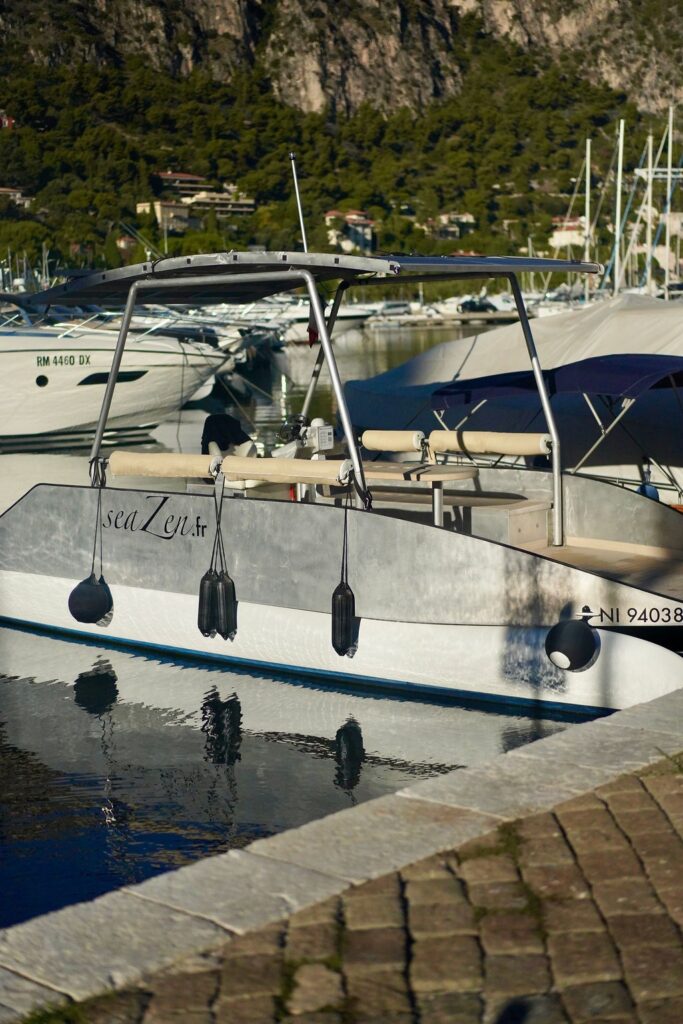
This short-range focus opens up new possibilities with electric boats that are slower and centred on the user experience. “At three knots, sitting at the front with their feet in the water, passengers are mesmerised. They don’t move,” the entrepreneur, who offers this experience for hire with SeaZen, said. Even better: slow navigation allows passengers to dine on board without being bothered by exhaust fumes from a combustion engine, turning the boat into a floating terrace.
The Côte d’Azur as a pioneer
“Our region is the true global cradle of low-impact leisure boating,” the AFBE member concluded. It’s a title that key players around the Mediterranean coastline are working hard to earn. At the forefront is Monaco, committed to protecting the Pelagos sanctuary and actively researching alternative propulsion systems since 2014, and also the city of Nice, which hosted the United Nations Ocean Conference in 2025 and will soon welcome the Nice Boating Tomorrow show, from 19 to 22 March 2026, dedicated to responsible boating.