

Matcha takes over Monaco’s cafés, a growing trend from Japan

© Pixabay
From Tokyo to Monaco, powdered green tea is winning over fans of healthy drinks. The Principality now boasts several places where the ancient beverage can be enjoyed.
In recent years, matcha has become the trendiest drink, driven by global hype. Monaco has been quick to join the movement: from chains like Starbucks to the most prestigious establishments including the Fairmont and Cédric Grolet Monte-Carlo, as well as specialised shops like Superboba, the Principality has gone green.
Matcha appeals first and foremost for its health benefits. Rich in antioxidants and theine, it offers a gradual energy boost without the jitteriness of coffee. L-theanine, an amino acid present in matcha, allows caffeine to be released slowly. The result: a stimulating effect that lasts for several hours without an energy crash. (Be sure to limit consumption to two cups per day maximum.)
The Japanese speciality requires a meticulous process. Tea plants are deprived of light for several weeks before harvest. This technique alters the aromatic compounds and gives matcha its characteristic umami profile (the fifth basic taste along with sweet, salty, sour and bitter). The leaves are then ground between two stone wheels. This stage determines the fineness of the vivid jade green powder.
How to make a good matcha?
Traditional matcha requires special utensils: a bowl (chawan), a bamboo whisk (chasen) and a tea spatula. The method: sift a level teaspoon of matcha into the bowl, pour in 5 cl of water heated to 70°C, then whisk energetically in a W motion until a foam forms.
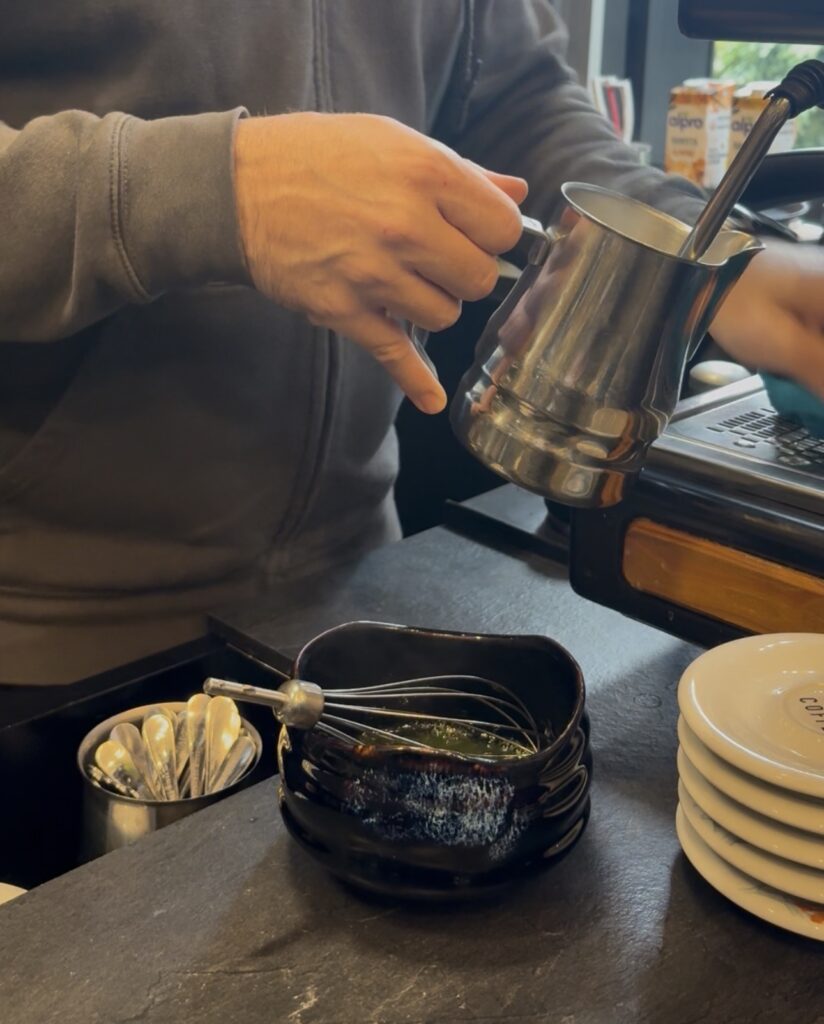
For a matcha latte, it’s simpler. Just mix the matcha with a little hot water, whisk it, then add frothed milk. Oat milk is particularly popular, but coconut milk can be used for a sweeter version.
- A good matcha can be identified by its Japanese origin, its colour, the fineness of its powder and ideally an organic certification.
A shifting clientele
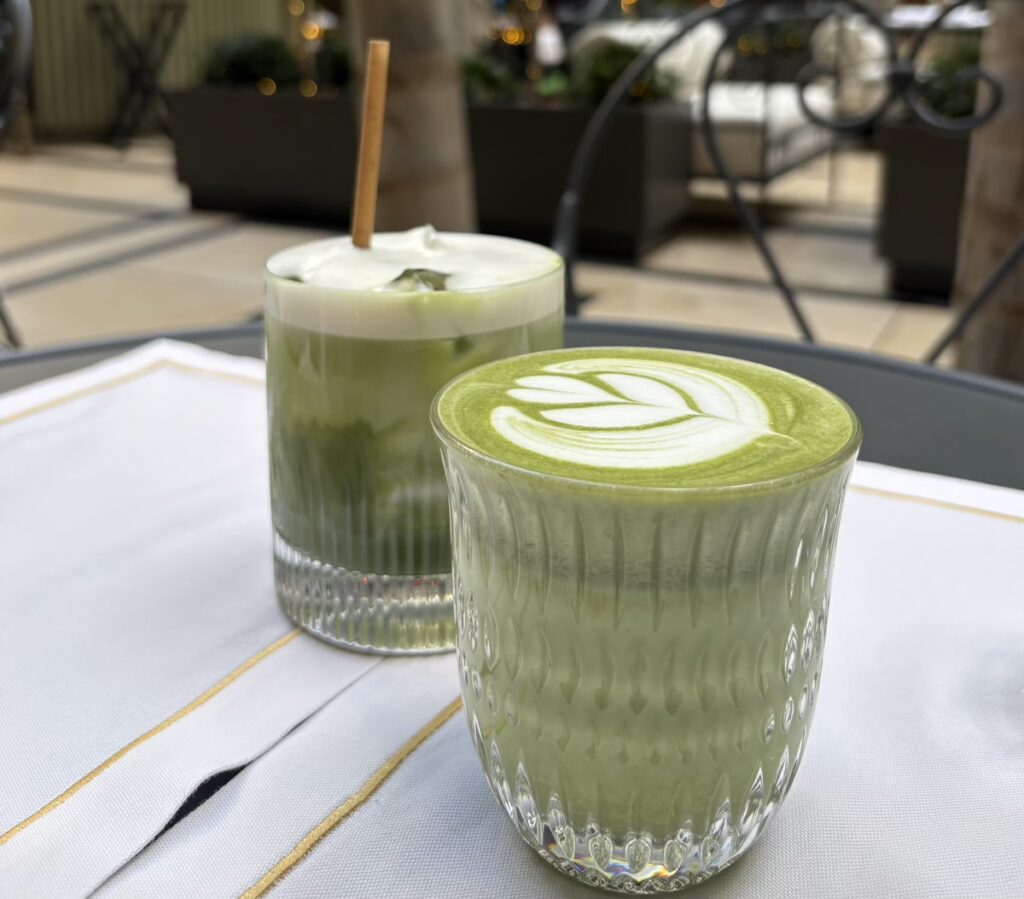
In the Principality, matcha’s clientele has radically changed: “In the beginning, most of my customers were Asian. Now, with the trend effect, I sell it to a much wider public,” noted Sharon, who offers exclusively organic matcha in her shops on Boulevard des Moulins and Rue Princesse Caroline. The democratisation is reflected in people’s preferences too: “Matcha with oat milk is what’s most in demand in Monaco,” Alessandro, barista at Costadoro Social Coffee, said. He will continue preparing them through April–May, the period of highest demand.
Luxury establishments are also following the trend. At Cédric Grolet Monte-Carlo, Raphaël Solakyan, manager of the tea room, does not compromise on quality: “It’s ceremonial-grade matcha [a superior matcha grade], imported directly from Japan.” The drink varies according to taste: cold with coconut milk for a softer version, or hot with cow’s milk for a creamier result. “The pairing with the house pastries, particularly the pear pastry, works especially well,” Raphaël Solakyan explained, who has noticed a real enthusiasm for the drink. Customers come to enjoy authentic Japanese matcha in a refined setting. It’s so successful that the drink has become a staple of the menu.
The challenges of a strained market
But behind the enthusiasm lies a concerning reality. “Matcha runs out quickly. It’s becoming tricky to keep offering it,” warned Sharon, manager of Superboba. Japan, the world’s leading producer and exporter, experienced an unprecedented shortage in 2024. Some historic brands sold out their collections in record time. They had to raise prices and limit purchases to one item per person. Yet Japanese production tripled between 2010 and 2023, increasing from 1,471 to 4,176 tonnes according to the Japanese Ministry of Agriculture. But global demand is exploding faster than production capacity. The country faces several constraints: lack of agricultural space, the need to standardise certain cultivars ideal for matcha, and above all a dramatic decrease in the number of producers. Numbers fell from 53,000 in 2000 to just 12,353 in 2020.
In Monaco, the matcha phenomenon has created unfair competition. Sharon sounded the alarm: “Other businesses, dark kitchens, don’t follow Monegasque regulations. They deliver in plastic cups. We make the effort to follow the rules,” she says.
Regulatory compliance has a cost, notably aesthetic, in a market where image plays a crucial role. “I deliver in recyclable cardboard cups. In photos, it obviously looks less good,” Sharon said. It’s a dilemma for the shopkeeper who refuses to compromise on compliance with the rules, even if it harms the photogenic appeal of her products on social media, where the trendy drink is showcased. Beyond regulatory issues, Sharon also warns consumers of a more fundamental concern: the quality of the product being sold.
Other countries, such as China, have begun producing matcha. The problem: these teas are made industrially, without following the rigorous process established by Japanese producers over centuries. They are indeed much cheaper, but of significantly lower quality. And since there is no strict international control, it is possible to call all sorts of derivatives “matcha”, creating dangerous confusion for consumers. This is precisely what Monegasque shopkeepers like Sharon fight against daily, relying on traceability, organic certification and direct imports from Japan. “Consumers still don’t really know how to tell the difference between real quality matcha and fake matcha from China. There’s a real need for education on this subject,” Sharon warned.
In Monaco, the Japanese drink seems to have firmly taken hold. Establishments that prioritise quality and transparency are counting on a clientele that is increasingly knowledgeable and quality-conscious.