










How to elevate your personal brand on LinkedIn: a practical guide for today’s professionals

LinkedIn today: a platform transforming professional visibility / Photo by Luxury Marketing Connect Monaco
LinkedIn is no longer a passive CV database, it has evolved into one of the most powerful personal branding platforms available.
With 1.2 billion members and growing, the platform has recorded four consecutive years of double-digit growth. User engagement continues to rise: comments increased by more than 30% this year, and video uploads rose by more than 20% as highlighted on Microsoft’s latest report. This shift signals that professionals are no longer simply observing; they are actively participating, sharing insights, and building digital presence.
The platform’s rapid integration of AI tools, from automated writing suggestions to advanced networking recommendations, reinforces its role as a central professional ecosystem. Strengthen your reputation, attract clients, communicate expertise, or nurture new opportunities, with LinkedIn you have the infrastructure to do it.
But to see real results, you need more than activity. You need a structure, a strategy that clarifies what you say, how you say it, and why it matters.
In this article we are going to guide you through a step-by step guide on how to create your LinkedIn strategy for your professional profile and strengthen your personal branding digitally.


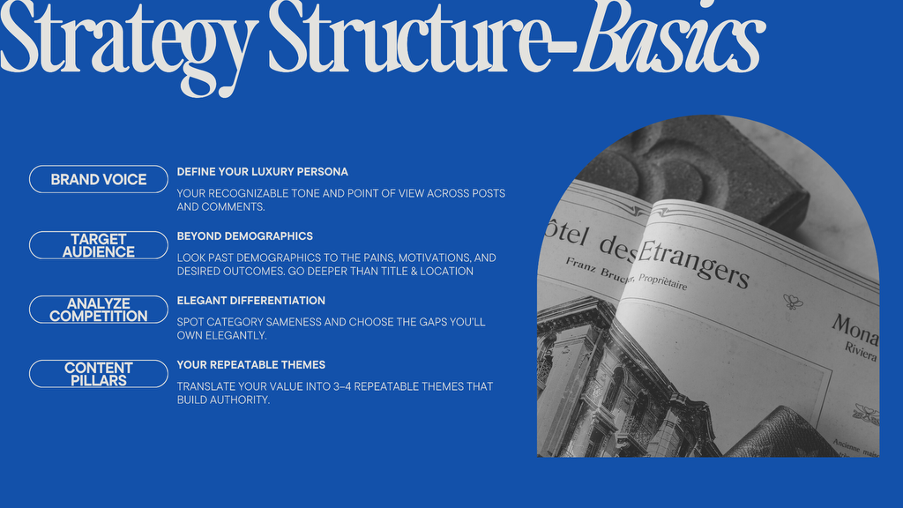
Step 1. Defining Your Brand Voice: How You Communicate Shapes Perception
Your brand voice is not about sounding clever or polished, it’s about consistency and recognisability. It is the emotional tone and personality behind your communication, the thread that connects your posts, comments, and messages.
A clear brand voice helps your audience understand you immediately. It builds familiarity, which in turn builds trust.
To define your brand voice, start by choosing traits that reflect the professional you are (or aspire to be). For some, this may be analytical and precise. For others, it may be warm and reflective. For others still, bold, energetic, or educational. These traits help you stay aligned with your messaging and avoid sounding inconsistent or generic.
ACTION, Write Your Brand Voice Guidelines
- Choose 3–5 voice traits (e.g., “discreet, insightful, exacting, warm, cosmopolitan”).
- Set guardrails: what you always do (e.g., back claims with proof) and never do (e.g., gossip, price talk without context).
Step 2. Understanding Your Target Audience: Speak to Their Reality, Not Their Title
Knowing your audience is one of the most overlooked aspects of personal branding. Many professionals describe their audience superficially, based on job titles, industries, or seniority, without understanding what makes them act.
Real audience understanding goes deeper. It examines:
- What challenges your audience faces
- What questions they struggle to answer
- What slows them down or creates uncertainty
- What they want more of: clarity, growth, confidence, innovation, efficiency
- How familiar they already are with your expertise
- What content formats they engage with most
This level of understanding helps you create content that feels relevant, timely, and valuable.
A strong LinkedIn strategy speaks to three levels of audience awareness:
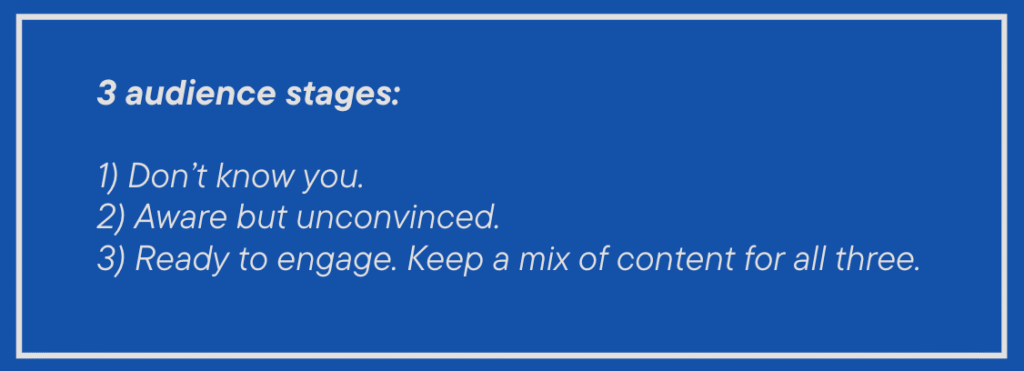
When your content is tailored to these levels, you build a powerful professional narrative that guides people naturally from awareness to trust.
ACTION, Profile Your Audience
Write a paragraph answering:
“What is my audience trying to achieve, and what is preventing them from achieving it?”
Step 3. Analysing the Competition: Understand the Landscape to Stand Out
Competitive analysis is not about imitation. It’s about clarity. By studying the people in your field who are active on LinkedIn, you begin to understand what is common, expected, or repetitive. This reveals the “category norms”, patterns that everyone follows, often without questioning.
These patterns might include similar post topics, predictable tones, overused phrasing, or the same type of educational content repeated endlessly.
Once you recognise these norms, you can choose your differentiation strategy: your angle, your tone, your examples, your depth, or your storytelling style. This subtle distinction is often what builds authority.
ACTION, Spot Your Differentiation Gap
Choose two competitors or profiles you like and note:
- What they talk about
- How often they post
- What tone they use
- What’s missing
Then write one sentence defining how you will stand apart.
Step4. Building Your Content Pillars: The Architecture of Your Personal Brand
Content pillars are the themes that define your expertise. They ensure your posts feel organised, valuable, and aligned with your positioning.
Effective pillars do three things:
1. Reflect the problems your audience experiences regularly.
2. Showcase your expertise through real examples, frameworks, or stories.
3. Position you as a professional with clarity and depth.
Your pillars may be based on: industry insights, behind-the-scenes experiences, step-by-step frameworks, lessons learned, thought leadership, or case stories. They allow your audience to recognise the areas in which you excel, and create expectations around the value you deliver.
Strong pillars also prevent the common feeling of “I don’t know what to post.” You’re never starting from zero; you’re rotating through the themes that define you.
ACTION, Define Your Four Content Pillars
For each pillar, write:
1. The purpose of the pillar: Why this pillar exists (value to audience + brand positioning).
2. What content it includes: Raw ideas of content.
3. Which formats you’ll use: text / doc carousel / video / photo set / article.
How often you’ll post about it: 3-4 post weekly is the LinkedIn recommendation.
5. Creating Valuable Content: Storytelling That Builds Connection
Educational content is essential, but without storytelling, it falls flat. People remember the emotion behind the lesson, not just the lesson itself.
Strong LinkedIn storytelling uses elements such as: relatability (shared experiences), struggle (professional challenges), and passion (the “why” behind your work). These elements make your message human and memorable.
The most effective content blends expertise with humanity. It teaches something useful while revealing something true about the author.
ACTION, Pick a Story Device for Your Next Post
Choose one: relatability, struggle, passion, teaching, discovery, reporting, or overcoming. Write one sentence describing the angle you’ll explore.
6. Mastering Post Types: A Balanced Mix Builds Impact
LinkedIn offers multiple ways to express your voice. A well-rounded presence uses a balanced mix of post types:
- personal stories and reflections
- educational insights
- situational commentary on news or trends
- lighter human moments
- professional updates or offers
This mix ensures your profile remains engaging, varied, and representative of your full professional identity.
A common mistake is relying too heavily on one content type, usually either purely educational posts or exclusively personal stories. Balance is what creates depth.
ACTION, Plan Your Next Five Posts
Include:
- 1 personal reflection
- 2 educational insights
- 1 timely commentary
- 1 professional update or offer
Step 7. The Anatomy of a High-Performing LinkedIn Post
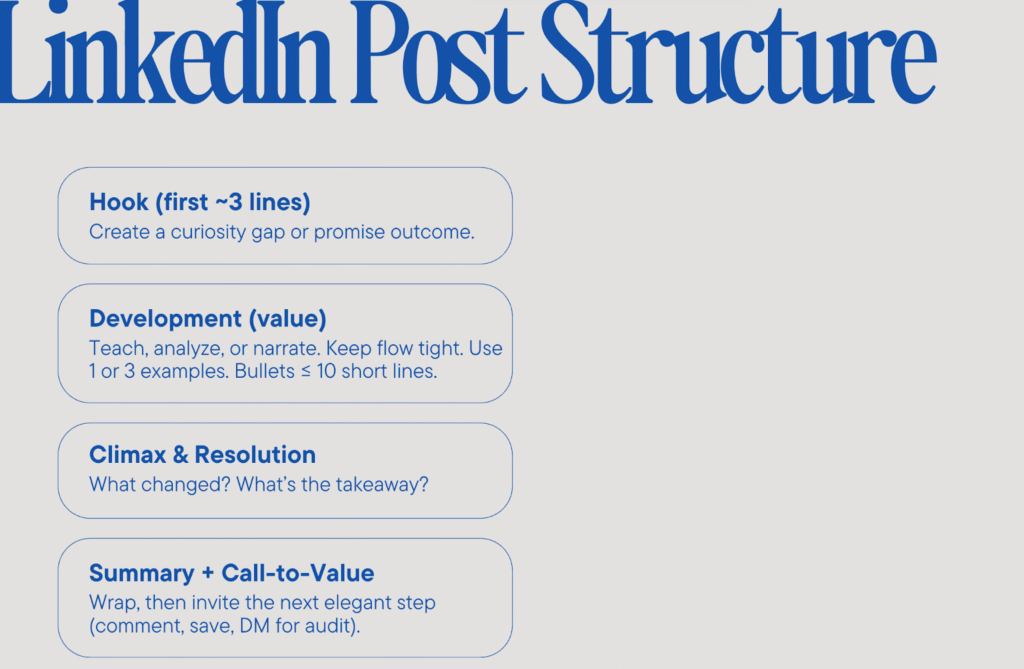
Every strong post follows a structure that respects how people read online. It begins with a compelling hook, the essential first three lines that determine whether someone will click “See more.”
The body of the post delivers the value: an insight, a story, or a framework. The resolution makes the takeaway clear. And the call-to-value invites the reader to reflect, engage, or act.
This structure isn’t restrictive; it’s effective. It ensures clarity, flow, and impact, regardless of topic.
ACTION, Build Your Post with This Structure
1. Hook, spark curiosity
2. Development, share insight or story
3. Resolution, highlight lesson
4. Call-to-value, invite a next step
Step 8. The Content Creation Workflow: Turning Strategy Into Habit
Consistency is not about volume; it’s about process. A reliable workflow removes friction and helps you create strong content even on busy days.
The workflow includes: choosing a pillar, identifying the audience stage, selecting a story, picking a post type, choosing the format, and constructing the post using the hook-value-resolution pattern.
When you follow this structure, you don’t rely on inspiration, you rely on intention.
ACTION, Follow the 6-Step Creation Method
1. Choose pillar
2. Choose audience stage
3. Choose topic + story
4. Choose post type
5. Choose format
6. Build the post
Step 9. The Power of Interaction: Visibility Built Through Contribution
Interaction is one of the strongest signals to LinkedIn’s algorithm. Thoughtful engagement before and after posting dramatically increases reach, but more importantly, it builds relationships.
Engaging with others’ content shows presence, curiosity, and expertise. Responding quickly to comments builds loyalty. Participating in meaningful conversations expands your network naturally.
Visibility on LinkedIn isn’t achieved by posting alone, it’s achieved by contributing.
ACTION, Apply the 15-Minute Rule
Before posting: comment meaningfully on 3–5 posts.
After posting: stay active for 15–30 minutes.
Every day: join conversations that align with your expertise.
A Strong LinkedIn Strategy Isn’t Optional Anymore. It’s Your Competitive Edge
Your personal brand is shaped by how intentionally and consistently you show up. With a clear strategy, a distinctive voice, structured content, and meaningful interaction, LinkedIn becomes a powerful ecosystem for professional growth, regardless of industry or career stage.
Your personal brand is not defined by isolated posts or sporadic activity. It is shaped by the clarity of your strategy, the consistency of your presence, and the authenticity of your interactions. When you combine a clear brand voice, a deep understanding of your audience, a thoughtful content structure, and a commitment to meaningful engagement, LinkedIn becomes a true extension of your professional identity.
This work pays off. Not instantly, but steadily. Visibility grows. Conversations multiply. Trust strengthens. People start recognising your expertise before you even enter the room. And over time, this digital presence becomes one of your most powerful professional assets, supporting your goals no matter your industry or stage in your career.
Build your strategy. Show up consistently. Share generously. Engage meaningfully. Your future network, collaborations, and opportunities are already on LinkedIn.
For more insights, resources, and support on marketing and PR visit: www.luxurymarketingconnectmonaco.mc
Author: Carolina Gonzalez