




GEMLUC: 50 years of fighting cancer in Monaco
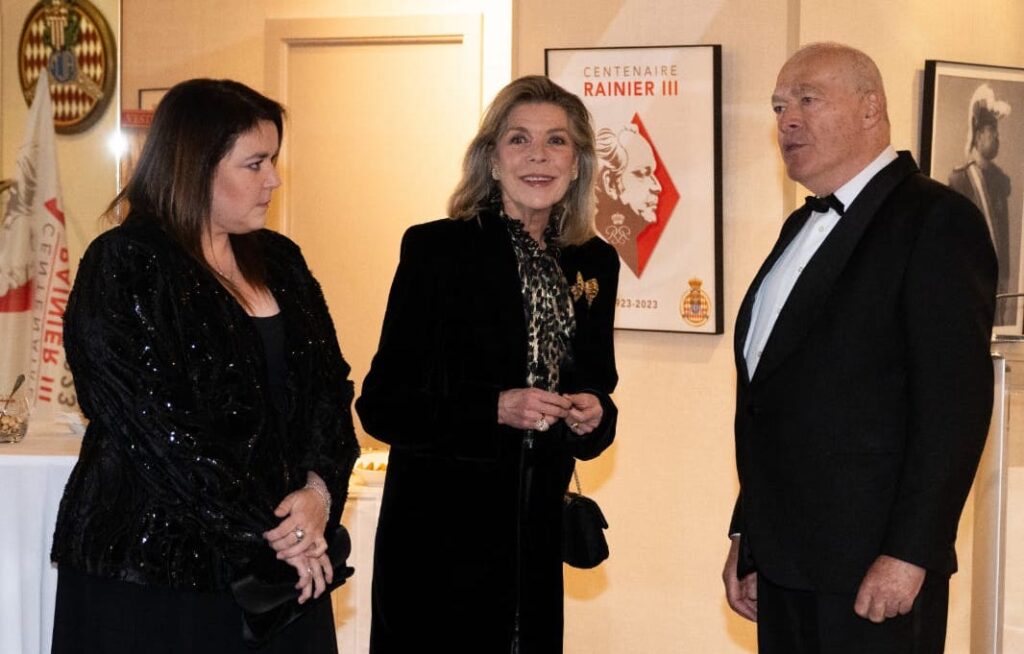
Princess Caroline, Mélanie-Antoinette de Massy and François-Jean Brych on 22 November 2023 at the Soirée de l’Espoir at the Automobile Club de Monaco © All rights reserved
Founded in 1973, Monaco’s oldest cancer-fighting charity combines philanthropic tradition and medical innovation, driven by a remarkable legacy and renewed international ambitions.
At the premises of the Centre Scientifique de Monaco (CSM – Monaco Scientific Centre), François-Jean Brych listened attentively to Dr Vincent Picco, Head of Research and head of the cancer research unit at the CSM. GEMLUC has just financed two PhD research projects focused on improving treatments for aggressive brain tumours. With this latest investment of €340,000 covering the period 2023–2027—bringing total financial support for the CSM to over €1 million since 2016—the charity continues its long philanthropic tradition in the Principality. “Founded in 1973 with the support of Princess Grace, GEMLUC is the oldest charity fighting cancer in Monaco,” explained its current Chairman, François-Jean Brych, a chartered accountant who has headed the organisation for several decades.

Such longevity is no accident, as the charity continues to enjoy the support of the Princely Family. Since Princess Grace’s death in 1982, her daughter Princess Caroline of Hanover has carried on the commitment as Honorary President. “She has always supported us in an extraordinary way,” François-Jean Brych said, adding with emotion, “Even when the charity experiences ups and downs, she is always by our side.”
The legacy of Princess Grace
Among Monaco’s charitable organisations, GEMLUC stands apart. “Every single donation is passed on,” its Chairman insisted. Not a cent goes to overheads, which are entirely covered by board members. “We are all volunteers—that’s our trademark.” The transparency appeals to donors in Monaco, who are used to many calls for support.


The charity’s vice-president, Dr Benoît Paulmier, ensures that all funded projects are approved by a scientific committee, once again guaranteeing that every euro translates into tangible results.

The financial rigour also convinced Richard Pollock, a British architect based in Monaco, to leave €4.5 million to the charity upon his death on 15 January 2015. His bequest made it possible to create the Fondation GEMLUC-Pollock, securing the charity’s future with a reserve fund. François-Jean Brych expressed his pride: “Despite my respectable age, I can assure you that in twenty years, GEMLUC will still be here.”
Concrete action against the disease
At the CHPG, some of the equipment funded by the charity has made a real difference. About ten years ago, the gastroenterology department led by Dr Patrick Rampal—former president of the CSM—received a confocal microscope. “Nobody wanted to pay for one,” François-Jean Brych recalled. “We did, and you know what? Today, the whole world comes here to train.” It’s a justifiable source of pride for an investment that helped place Monaco more firmly on the map of medical innovation.
But the charity does not rest on its laurels. Its latest investment at the CSM is resolutely future-oriented, supporting the next generation of researchers. The aim of the two PhD projects funded is to make cancer cells more sensitive to radiotherapy—a breakthrough that could revolutionise treatment. “Today, almost every family is affected by cancer. That wasn’t the case when I started in 1978,” the chairman of GEMLUC’s board recalled.

People at the heart of the mission
Behind the figures and advanced technology are human stories—those of patients unable to afford a €1,500 genetic sequencing test that could personalise their treatment, making chemotherapy or immunotherapy more targeted and effective. Since 2024, GEMLUC has partially financed genetic testing prescribed at the CHPG to tailor cancer treatments. “We’re providing €100,000 to expand access to these analyses, reducing their cost to around €1,000,” François-Jean Brych explained.
Approached by another charity, Écoute Cancer Réconfort, GEMLUC recently took a new step by funding a 3D breast reconstruction system. “Being able to tell a woman she will regain the same breast as before her illness—only younger—costs €4,000 per patient, but our board didn’t hesitate for a second.” The restrained emotion in François-Jean Brych’s voice reflected the deep human impact of such decisions.
Monaco–Dubai: a bridge in the fight against cancer
Internationally, Expo 2020 Dubai opened unexpected opportunities. Thanks to Dr Paulmier, a three-year partnership was established with the University of Dubai. “These exchanges are very important and very interesting for the future,” François-Jean Brych said enthusiastically, viewing the collaboration as a new way to advance research beyond Monaco’s borders.
The outward momentum continues. The charity hopes to relaunch the long-dormant International Federation of Companies Against Cancer (FIELUC). “We have to get it going again. We’re going to bring in France and Italy—and it will be a springboard to America!” It’s an ambitious project that reflects the charity’s renewed momentum.

La Soirée de l’Espoir (The Evening of Hope) – an annual gathering
Every year, the same ritual brings donors together. François-Jean Brych admitted with a smile: “I’m always a little nervous, because we still have to manage to bring together 400 people.” But on 8 November last year, as in every edition, the Soirée de l’Espoir was a full house. Princess Caroline of Hanover attended, true to tradition. This year’s event will take place on 6 November.
Monaco’s sporting world also contributes. Prince Albert II personally handed over a cheque for €37,204 after the Rolex Monte-Carlo Masters 2025 final, while Mélanie-Antoinette de Massy, head of the Monegasque Tennis Federation, continues to foster initiatives in support of the charity.

Passing the torch
Now aged 73, François-Jean Brych is thinking about the future: “My priority is to hand GEMLUC over to a younger generation as passionate as we have been.” Vice-president Dr Benoît Paulmier already embodies that continuity. Between tradition and modernity, the charity seeks balance for the decades ahead.
When asked why he has remained devoted to the cancer cause, despite his own heart problems that might have led him elsewhere, François-Jean Brych answered simply: “I have always been convinced of the value of our mission.” It’s a loyalty that sums up fifty years of commitment—between medical breakthroughs and human stories—in a Principality where philanthropy is not just a word, but an enduring tradition.