


From Milan 2026 to Monaco: remembering Giorgio Armani and his enduring bond with Princess Charlene
Frederic Nebinger
From the Milan-Cortina Winter Olympics to Princess Charlene’s iconic wedding dress, we look back at the unbreakable ties that bound the king of Italian fashion to the Principality.
The Milan-Cortina 2026 Winter Olympics will not only showcase the exploits of athletes from around the world. They will also pay tribute to one of the biggest names in Italian fashion. At the San Siro Stadium in Milan, the opening ceremony of the 25th Winter Olympics placed Giorgio Armani at the heart of the show.
During the presentation of the flag to the guard of honour, sixty models dressed in monochrome Giorgio Armani trouser suits in the colours of the Italian flag paraded ahead of flag bearer Vittoria Ceretti, the face of the fashion house’s new spring-summer 2026 campaign. A black-and-white portrait of the designer, who passed away on 4 September, was also projected onto the stadium’s giant screens.
One designer, one vision, one era
Born on 11 July 1934 in Piacenza, Giorgio Armani grew up in post-war Italy before revolutionising global fashion from Milan. After abandoning his medical studies and working at La Rinascente, he founded his own fashion house in 1975 with his partner Sergio Galeotti. His signature style is characterised by fluid lines, bare shoulders, neutral tones and an elegance stripped of all superfluous artifice. ‘Elegance is not about standing out, but about being memorable,’ he liked to say.
From the catwalks of Milan to the red carpets of Hollywood, Armani quickly established himself as the couturier of stars and royalty. His empire extends far beyond fashion to include hotels, restaurants, cosmetics and interior design.
From Princess Grace to Princess Gabriella: how Dior became part of Monaco’s princely legacy
A lover of the French Riviera
Giorgio Armani fell in love with the Mediterranean. Saint-Tropez was his refuge; he owned a villa and a yacht there and was a regular at the legendary Club 55. The French Riviera, with its gentle way of life, naturally resonated with his aesthetic. His southern sensibility found the ideal outlet for expression just a few kilometres away from Monaco.
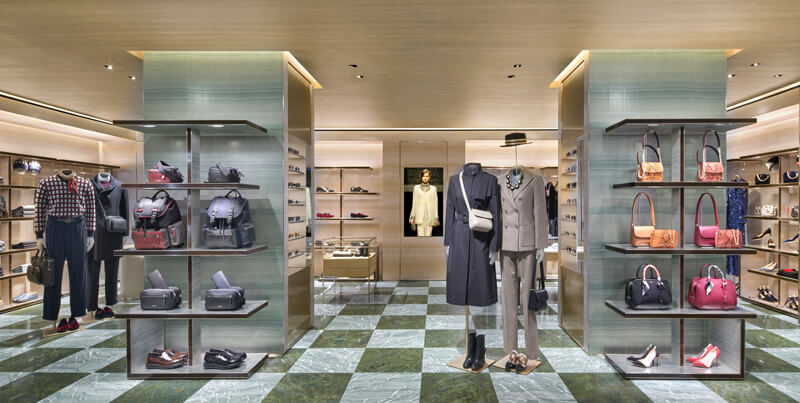
In 2020, he took another step forward by opening a 150 m² boutique at the Hôtel Hermitage in Monte Carlo, which he personally designed. A space that reflects his image, thought out down to the smallest detail. The Principality also provided Giorgio Armani with one of his most unexpected ambassadors: Charles Leclerc. In 2020, the Scuderia Ferrari driver became the face of the spring-summer ‘Sur mesure’ collection. The Monegasque driver himself announced the news on Instagram: “Extremely happy to announce that I am now an ambassador for Giorgio Armani and his Sur Mesure line. Fashion, like music and motor racing, has always been one of my passions. Representing such an iconic brand is a huge honour. “
The wedding dress of the century
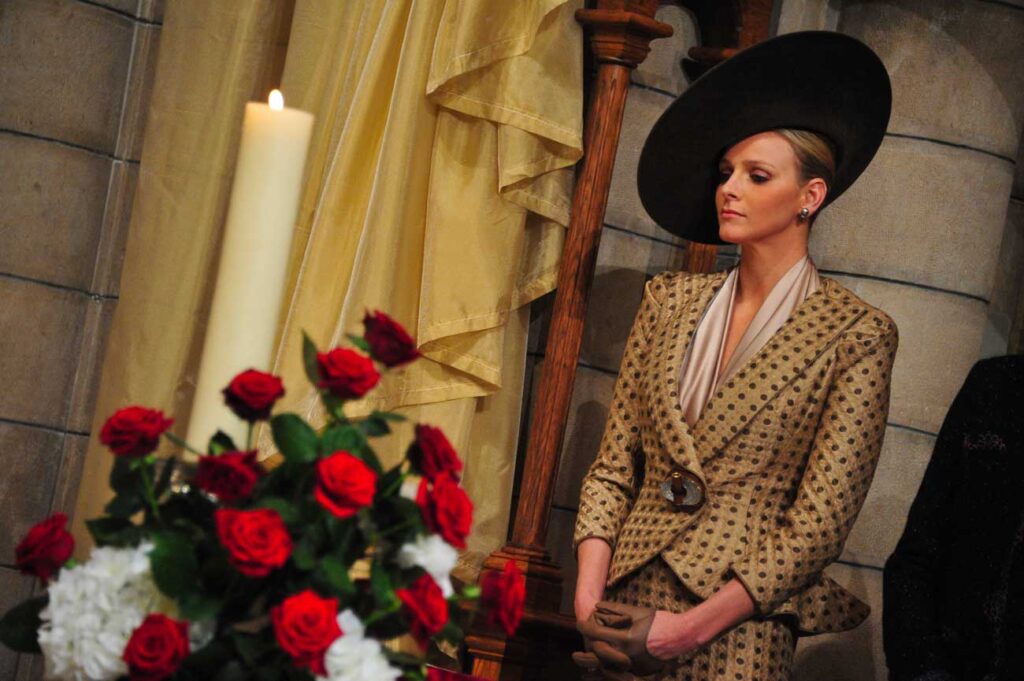
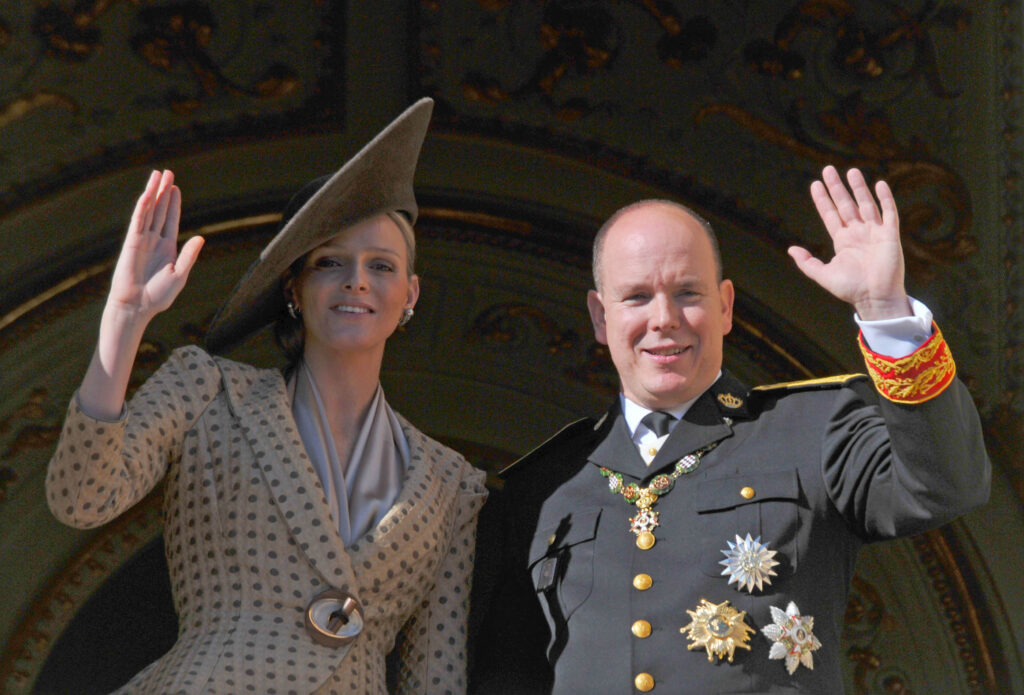
But it is undoubtedly the wedding of Prince Albert II and Charlene Wittstock on 2 July 2011 that constitutes the most memorable chapter in the history between Giorgio Armani and Monaco. A few months before the royal wedding, in November 2010, the future Princess wore a Giorgio Armani outfit to attend the Monegasque National Day mass, a first hint of what would become a lasting partnership.
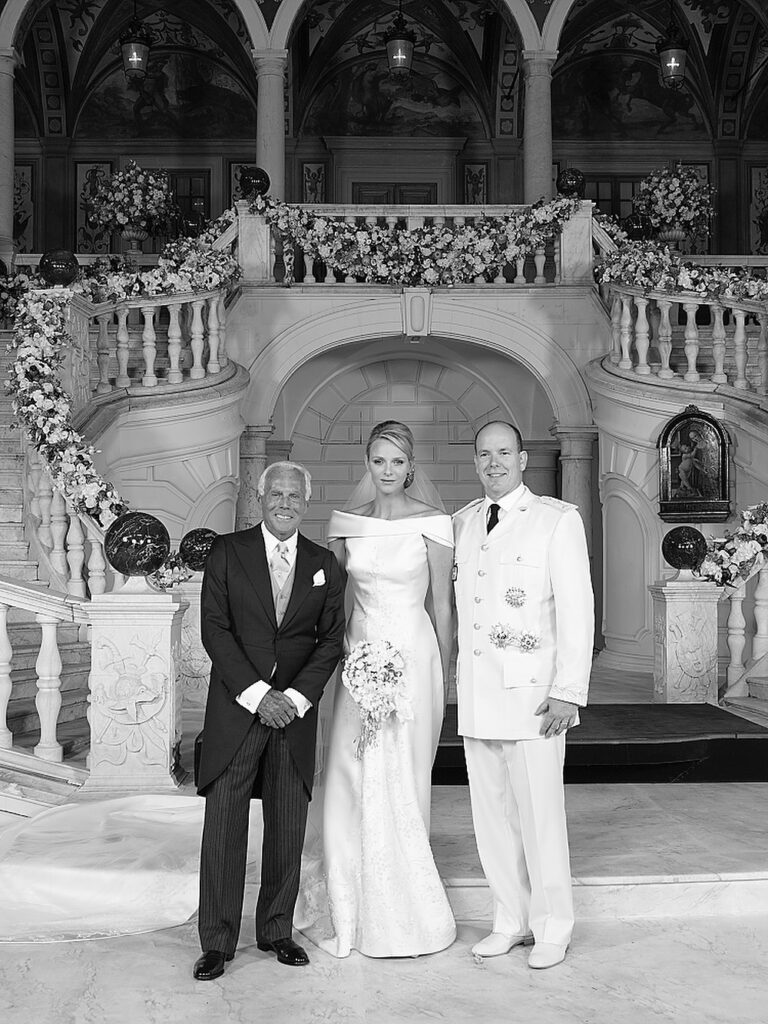
The secret of the wedding dress had been kept with absolute discretion. It was only when Princess Charlene stepped onto the red carpet at the Place du Palais that the guests discovered Armani’s masterpiece. An off-white duchess satin gown with a long train, crossed at the front and back, from which a second train known as ‘à l’andrienne’ emerged. The edge and centre of the train were embellished with a floral motif embroidered with 30,000 gold beads, 40,000 Swarovski crystals and 20,000 mother-of-pearl drops. This textile masterpiece of rare complexity required 2,500 hours of work (including 700 hours dedicated to embroidery alone). The veil, made of 20 metres of silk tulle with a purple front, required an additional 100 hours of embroidery. Armani also created the bride’s bouquet and her evening gown.
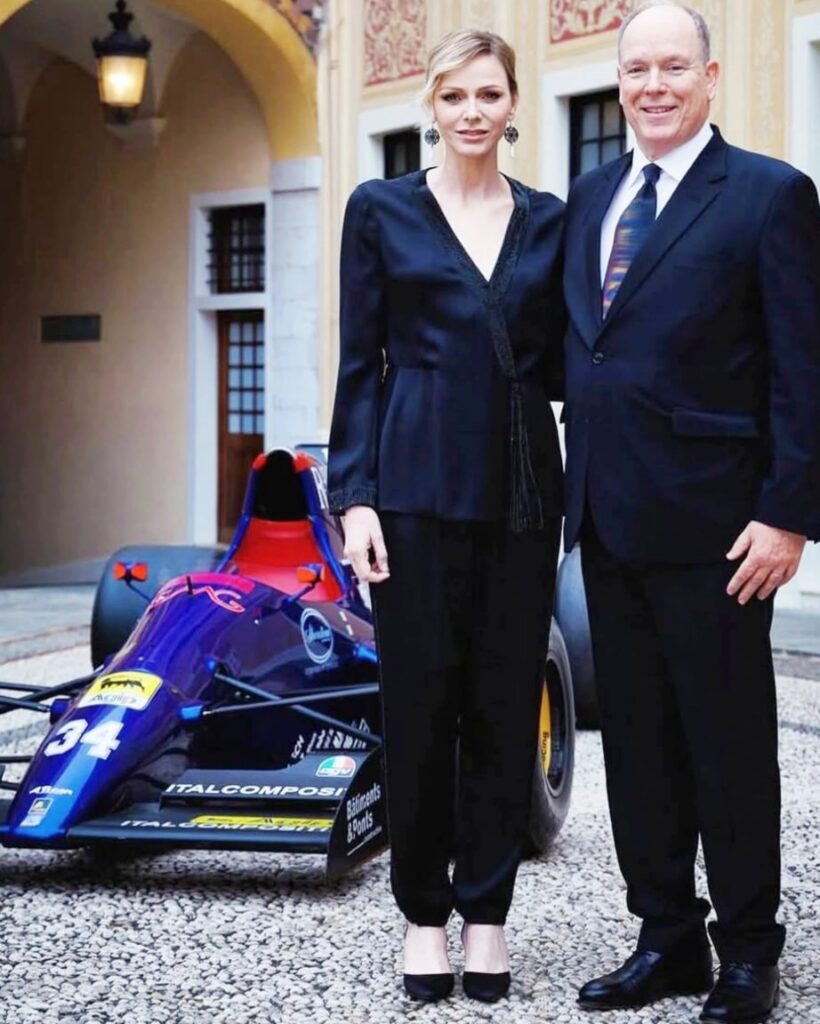
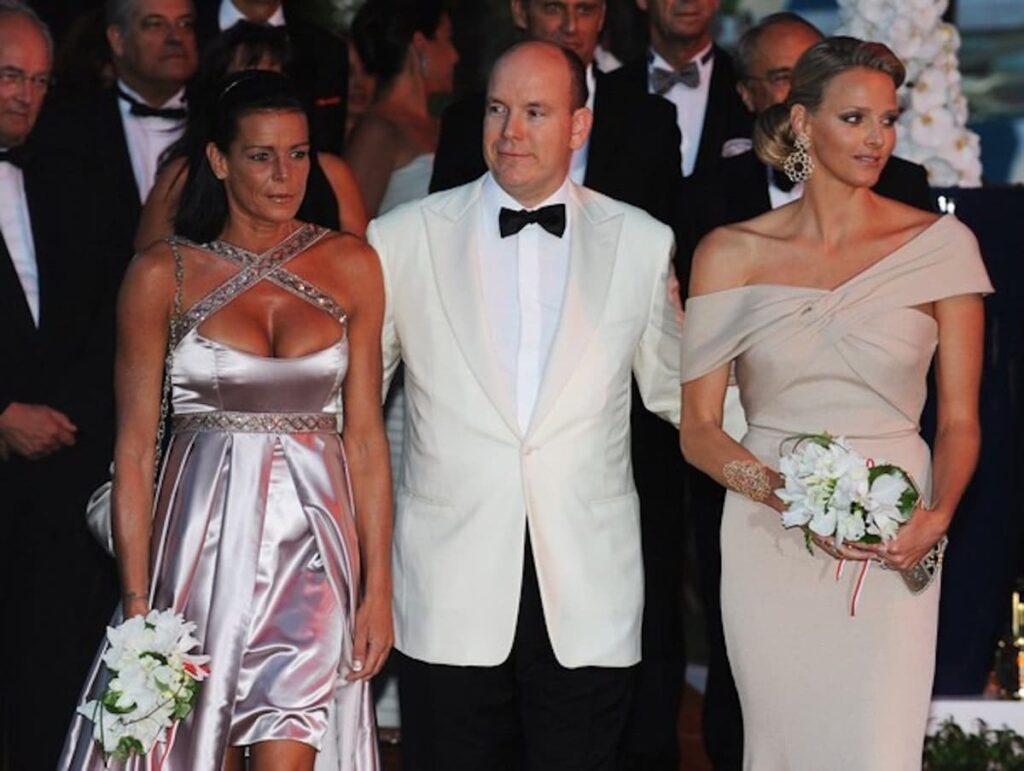
Over the years, Princess Charlene has made Armani one of her favourite designers for major official occasions. Her slender figure and regal bearing are a natural fit for the clean lines, light silks and understated tones favoured by the designer. On 30 July 2010, at the 62nd Monaco Red Cross Ball, the future Princess appeared alongside Prince Albert II in a long nude gown by Armani Privé. This was one of her very first notable appearances wearing this label.
Princess Caroline, Charlotte Casiraghi, Alexandra of Hanover: three generations embodying the spirit of Chanel
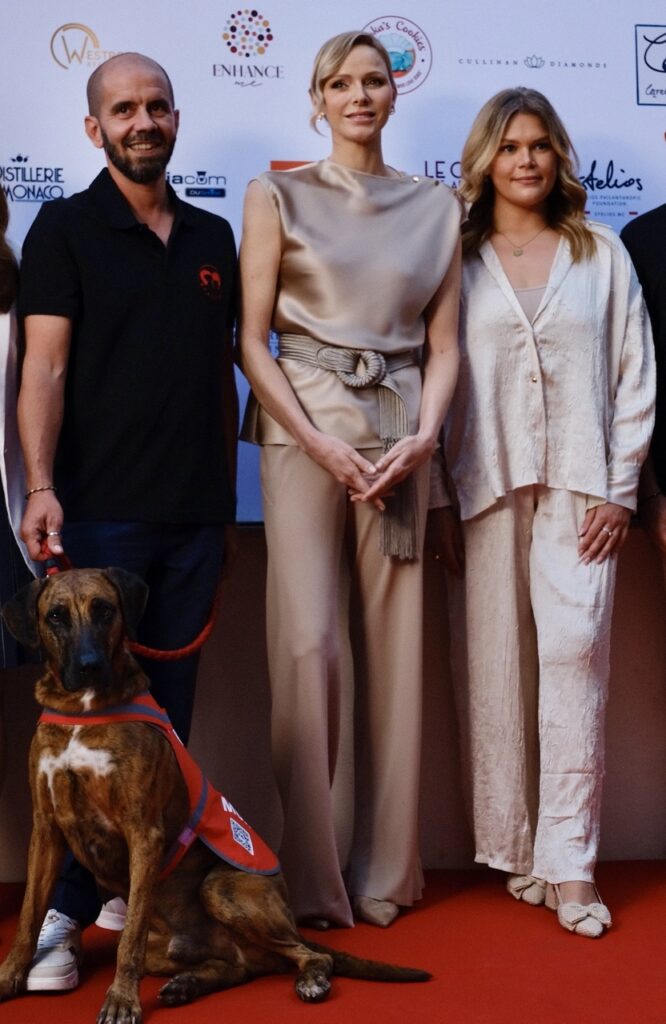
On 22 May 2025, she wore an Armani outfit to the official reception for the 82nd Monaco Formula 1 Grand Prix. Then, on 15 September 2025, after the couturier’s death, Princess Charlène paid him a personal tribute by wearing a beige silk Giorgio Armani ensemble, complete with a braided belt. It was a simple yet eloquent gesture to honour the memory of someone who was also a friend.
On 19 November 2025, for the National Day Gala at the Grimaldi Forum, she appeared in an all-white, long-sleeved dress by Armani Privé. The following day, for the official ceremony, she chose an immaculate white Armani trouser suit, accessorised with a veil-topped hat.

Upon hearing the news of the couturier’s passing, Princess Charlene expressed her grief openly. The Prince’s Palace of Monaco posted her message on social media: “It is with great sadness that the Prince and I learned of the death of Giorgio Armani. An iconic figure in the world of fashion, he created and shaped trends that influenced generations. Among his many creations was my wedding dress in July 2011. His work and achievements will live on and continue to inspire the future.”

Giorgio Armani passed away on 4 September 2025 in Milan, at the age of 91. In a career spanning fifty years, he transformed his fashion house, founded in 1975, into a global empire, imposing an inimitable style that transcended generations, borders and royal courts.