









Breastfeeding: busting myths to better support mums
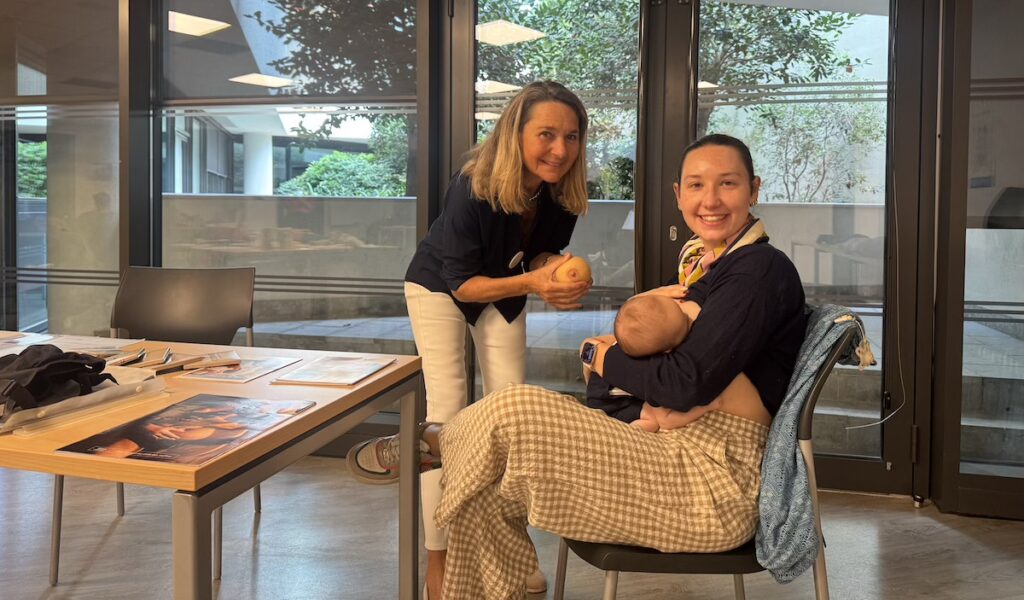
Brigitte Fino with Mariasole Artioli, who took part in the workshop on Thursday 16 October © Monaco Tribune
To mark World Breastfeeding Week, the Entreparents network organised a workshop to inform and support parents given the many misconceptions that persist about natural feeding.
Nature and learning
“Breastfeeding is natural, certainly, since a woman’s body is capable of carrying the pregnancy, delivering the baby and feeding it,” explains Brigitte Fino, a retired midwife and IBCLC (International Board Certified Lactation Consultant). “However, even though it’s natural, mums sometimes need a little help to be able to see their breastfeeding plans through.”
The difference between biological ability and concrete practice is the root of the issue. For the last fifteen years, Brigitte Fino has been running workshops to support parents through the breastfeeding adventure. Despite its physiological nature, it can be fraught with cultural and social obstacles.
Mother’s milk is always better than industrial milk


Misconceptions are hard to dispel
One of the most persistent myths is that ‘the milk isn’t nourishing enough’. “These are popular beliefs that, unfortunately, are spread by society,” says the consultant. “Mother’s milk is always better than industrial milk. The milk is always nourishing. It is made specifically for the moment the baby will feed.”
In fact, the World Health Organisation (WHO) recommends breastfeeding exclusively for six months, and continued breastfeeding for up to two years with a diversified diet. Contrary to popular belief, breast milk retains its nutritional properties well beyond the age of six months.
Another persistent misconception is that breastfeeding damages the breasts. “It’s age and pregnancy that change the body, not breastfeeding in particular,” Brigitte Fino points out with a knowing smile – it’s a recurring question.
A choice made under pressure
Mothers often find themselves torn. “Whether they breastfeed or not. When they do breastfeed they’re told their baby is always in their arms and always at their breast. And if they don’t breastfeed, they hear ‘But you didn’t even try to breastfeed,'” says the midwife.
Johanna Damar, who organised the event for Entreparents, stresses the initiative’s importance: “Supporting breastfeeding is about much more than promoting the practice: it’s about preserving a bond, supporting mothers’ and children’s health, promoting freedom of choice, and encouraging a more inclusive society.”
Noticeable cultural disparities
Monaco’s cultural diversity provides an unusual perspective on these issues. “The difference with Monaco is that there are a lot of foreigners, and therefore several different cultures,” says Brigitte Fino. Breastfeeding rates vary considerably from one country to another: around 95% in Scandinavian countries versus barely 80% in France and Monaco.
According to the specialist, the difference is purely cultural, but it raises the importance of social context with regard to breastfeeding. “We don’t have a breastfeeding culture,” she rues, referring in particular to the difficulties encountered by mothers who wish to breastfeed in public.
The maternal bond, an underestimated benefit
In addition to the well-documented physical benefits – lower risk of infection for baby, lower risk of cancer for mum – Brigitte Fino stresses an aspect that is often overlooked: the “quality of the bond” that develops between the mother and her child. “Breastfed babies are reassured by the closeness, a superior sense of security without a doubt,” she explains, stressing the fundamental emotional dimension of breastfeeding.
CHPG launches eco-responsible maternity kit for parents of newborns
Breastfeeding for working mums
Going back to work shouldn’t be an obstacle to breastfeeding. “Women are finding it easier and easier to continue breastfeeding, even after they go back to work,” says Brigitte Fino. Breast pumps allow mothers to keep up their milk production as they return to work. Women are entitled to use these devices in the workplace, an important step towards reconciling work and breastfeeding.
Free, accessible support
The workshops run by Entreparents have an “open door” format, allowing parents to come and ask questions as and when they arise. These free meetings are open to families from Monaco and neighbouring towns. Brigitte Fino runs monthly workshops at the Maison des Associations through Entreparents, as well as occasional events at Monaco Town Hall. A special workshop is also organised every year during World Breastfeeding Week.
The sessions include practical demonstrations (breastfeeding positions, ‘babywearing’, massage), presentations of helpful items and, above all, a space for parents to talk to each other. “The format means they can come and go. It’s not like a class with a beginning and an end,” explains the consultant.
The more we talk about breastfeeding, the better
The crucial role of family and friends
The partner plays a crucial role in the adventure. “The father is protective of his partner’s breastfeeding plans,” says the consultant. That support is all the more important as young parents often have to deal with unsolicited comments and advice from those around them.
Changing mindsets
Despite the obstacles, Brigitte Fino sees positive developments: “I think there is a growing awareness that breast milk is human milk for a human baby, and that it covers all the newborn’s needs. More and more couples are aware of the importance of diet to lifelong health.”
“The more we talk about breastfeeding, the better,” she concludes “Parents need to have access to the resources they need, be surrounded by competent people, and we need to put an end to preconceived ideas that are generally very harmful to breastfeeding.”